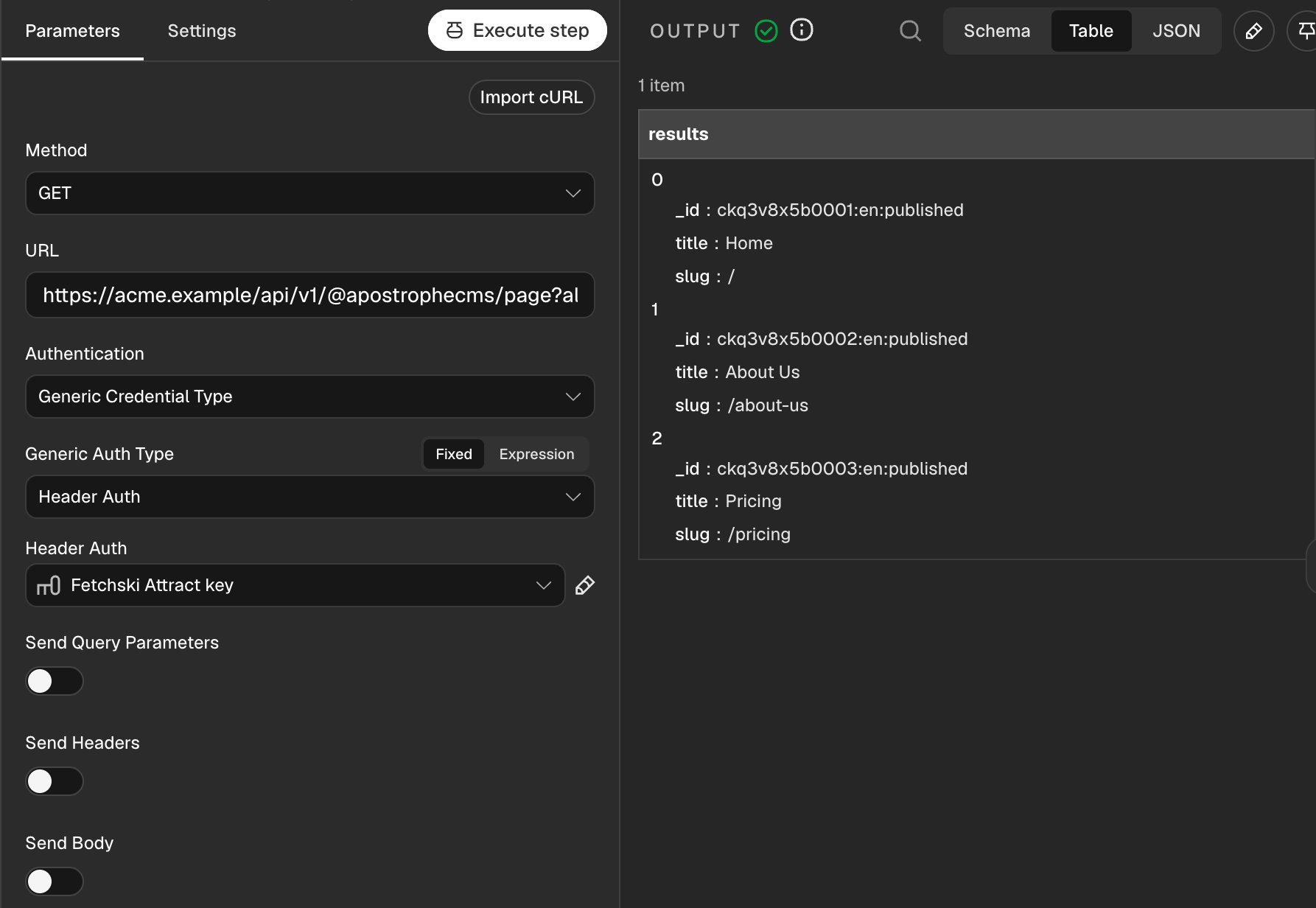
One HTTP Request node lists your pages’ ids, Split Out makes each page its own item, and a second HTTP Request node gets every page by its id.
&
Coming soon: the Fetchski Attract node for n8n
A full community node for the Attract API: every call a ready-made action, with your key and its
signing handled for you. Until it ships, n8n’s HTTP Request node reaches the whole API, as
this page shows.
Most calls name one document by its _id: get a page, change it, publish it. To reach every page,
chain three nodes:
1. List
One request answers every page’s _id, in a single item.
2. Split
Split Out turns that one item into one item per page.
3. Get each
n8n runs the next node once per item, with that page’s _id.
Set up your key first in Authenticate from n8n. It needs Pages: read
(content:pages:read): pick the Read pages pack. The steps below use a token only key;
With a signed key shows what changes.
Build it
List your pages
Add an HTTP Request node after your trigger, with this URL:
To write {{ $json._id }}, drag _id from the input panel on the left into the end of the
URL. n8n runs the node once per item, and {{ $json._id }} is that item’s id each time.
Get each page: the _id dragged into the URL
Run the workflow
Click Execute workflow.You should see1 item on the connector out of List your pages, and one item per page
out of One item per page and Get each page: each of those last items is a whole page,
every field and section included.
After a run: 1 item into Split Out, 3 items out of it, and Get each page called once for each
With a signed key
Token + signature on writes
Token + signature on every request
Nothing changes. This chain only reads, and this key signs only its writes, so the token alone
does it.
Reads are signed too, so each HTTP Request node gets What to sign and Sign it from
Authenticate from n8n just before it:The second What to sign runs once per page, and builds that page’s path from its id, so each
page gets its own signature:
Name
Type
Value
timestamp
Number
{{ $now.toUnixInteger() }}
method
String
GET
path
String
/api/v1/@apostrophecms/page/{{ $json._id }}
body
String
Empty
Get each page then takes its URL from that path, https://acme.example{{ $json.path }}, and
sends the two signature headers.
Going further
Change each page instead of reading it
Swap the last node’s method for PATCH, add ?aposMode=draft to its URL so only the draft
changes, and send the change as its body. The key needs Pages: write drafts
(content:pages:write). On a key that signs writes, put the body in What to sign and send
it Raw, as in Signing a write.
Drafts and locales explains the modes.
Other content types
Every piece type lists at GET /api/v1/<type> with the same fields, and answers one document
at GET /api/v1/<type>/{_id}. A piece list comes a page of results at a time: add
perPage=100 and walk page (the HTTP Request node’s Options → Pagination can do it).
Find a document’s id has the details.
Many pages at once
A key allows 600 reads and 120 writes a minute unless set otherwise. Over it, n8n says “The
service is receiving too many requests from you”: on Get each page open Options →
Batching and send fewer items a minute.
Related
Authenticate from n8n
Token only, or token and HMAC signature
Find a document's id
The fields parameter, and which id to send
List pages
The route, its parameters and its answer
Required scopes
Every operation’s scope, per content type
⌘I
{"docsConfig":{"theme":"almond","$schema":"https://mintlify.com/docs.json","name":"Fetchski Attract Docs","colors":{"primary":"#16a34a","light":"#22c55e","dark":"#15803d"},"logo":{"light":"https://mintcdn.com/fetchski-attract-api/mn9qfQRsqaASh7UE/logo/light.svg?fit=max\u0026auto=format\u0026n=mn9qfQRsqaASh7UE\u0026q=85\u0026s=66db13e248b70a44a5ff5f6990d4cb63","dark":"https://mintcdn.com/fetchski-attract-api/mn9qfQRsqaASh7UE/logo/dark.svg?fit=max\u0026auto=format\u0026n=mn9qfQRsqaASh7UE\u0026q=85\u0026s=86904ba8d47714303521b2dcd5aa2a50","href":"/"},"favicon":"https://mintcdn.com/fetchski-attract-api/mn9qfQRsqaASh7UE/favicon.svg?fit=max\u0026auto=format\u0026n=mn9qfQRsqaASh7UE\u0026q=85\u0026s=fd4f2c0615961c9e01c9762b98c8999f","api":{"playground":{"display":"interactive"},"examples":{"defaults":"required","languages":["bash","typescript","php"]}},"appearance":{"default":"dark"},"background":{"color":{"light":"#ffffff","dark":"#0b0e13"}},"search":{"prompt":"Search the docs…"},"seo":{"metatags":{"robots":"noindex, nofollow"}},"fonts":{"family":"Inter"},"icons":{"library":"fontawesome"},"styling":{"codeblocks":"dark","latex":true},"contextual":{"options":["copy","view"],"display":"header"},"navigation":{"pages":[]}},"deployment":{"deploymentMetadataValue":{"subdomain":"fetchski-attract-api","hasAudioNarration":false,"actualSubdomain":"fetchski-attract-api","customDomains":["docs.fetchski-attract.com"],"gitSource":{"type":"github","owner":"fetchski","repo":"fetchski_cms_astro_monorepo","deployBranch":"main","contentDirectory":"docs/attract","isPrivate":true,"mountPath":"","label":"","_id":"6adb9c232f0947a18a27541d"},"entitlements":{},"buildId":"6af6df04bd8b0362cdec74ff","clientVersion":"0.0.4131","searchFilterCounts":[{"language":"default","tag":"Media","count":953},{"language":"default","tag":"Content","count":863},{"language":"default","tag":"Publishing","count":720},{"language":"default","tag":"API reference","count":484},{"language":"default","tag":"Laravel","count":472},{"language":"default","tag":"TypeScript","count":470},{"language":"default","tag":"AdonisJS","count":469},{"language":"default","tag":"Batch jobs","count":364},{"language":"default","tag":"Pages \u0026 Site","count":224},{"language":"default","tag":"Forms","count":168}]},"assistantConfig":{"enableAskAiButton":false,"enableStarterQuestions":false,"enableContextualStarterQuestions":false,"enableAskAiSearchBar":true},"basePath":"","hasChatPermissions":false,"hasWebMcpPermissions":false,"toggles":[{"name":"kill-isr","enabled":true,"variant":{"name":"disabled","enabled":false,"feature_enabled":true},"impressionData":false},{"name":"custom-rbac-roles","enabled":true,"variant":{"name":"disabled","enabled":false,"feature_enabled":true},"impressionData":false},{"name":"agent-mintlify-slack","enabled":true,"variant":{"name":"disabled","enabled":false,"feature_enabled":true},"impressionData":false},{"name":"agent-integrations-settings","enabled":true,"variant":{"name":"disabled","enabled":false,"feature_enabled":true},"impressionData":false},{"name":"rbac-expansion","enabled":true,"variant":{"name":"disabled","enabled":false,"feature_enabled":true},"impressionData":false},{"name":"automations-pr-grouping","enabled":true,"variant":{"name":"disabled","enabled":false,"feature_enabled":true},"impressionData":false},{"name":"custom-prefix","enabled":true,"variant":{"name":"disabled","enabled":false,"feature_enabled":true},"impressionData":false},{"name":"analytics-v7","enabled":true,"variant":{"name":"disabled","enabled":false,"feature_enabled":true},"impressionData":false},{"name":"user-flows-analytics","enabled":true,"variant":{"name":"disabled","enabled":false,"feature_enabled":true},"impressionData":false},{"name":"no-publish-flow","enabled":true,"variant":{"name":"disabled","enabled":false,"feature_enabled":true},"impressionData":false},{"name":"workos-onboarding","enabled":true,"variant":{"name":"disabled","enabled":false,"feature_enabled":true},"impressionData":false},{"name":"snapshot-serving-live","enabled":true,"variant":{"name":"disabled","enabled":false,"feature_enabled":true},"impressionData":false},{"name":"stripTemperatureMiddleware","enabled":true,"variant":{"name":"disabled","enabled":false,"feature_enabled":true},"impressionData":false},{"name":"support-platform-pylon-zendesk","enabled":true,"variant":{"name":"disabled","enabled":false,"feature_enabled":true},"impressionData":false},{"name":"snapshot-serving","enabled":true,"variant":{"name":"disabled","enabled":false,"feature_enabled":true},"impressionData":false},{"name":"instant-rollback","enabled":true,"variant":{"name":"disabled","enabled":false,"feature_enabled":true},"impressionData":false},{"name":"granular-notifications-server","enabled":true,"variant":{"name":"disabled","enabled":false,"feature_enabled":true},"impressionData":false},{"name":"granular-notifications","enabled":true,"variant":{"name":"disabled","enabled":false,"feature_enabled":true},"impressionData":false},{"name":"automations-fable","enabled":true,"variant":{"name":"disabled","enabled":false,"feature_enabled":true},"impressionData":false},{"name":"fixed-ai-action-pricing","enabled":true,"variant":{"name":"disabled","enabled":false,"feature_enabled":true},"impressionData":false},{"name":"automation-resolve-merge-conflict","enabled":true,"variant":{"name":"disabled","enabled":false,"feature_enabled":true},"impressionData":false},{"name":"scoped-publishing","enabled":true,"variant":{"name":"disabled","enabled":false,"feature_enabled":true},"impressionData":false},{"name":"mintql","enabled":true,"variant":{"name":"disabled","enabled":false,"feature_enabled":true},"impressionData":false},{"name":"page-level-analytics","enabled":true,"variant":{"name":"disabled","enabled":false,"feature_enabled":true},"impressionData":false},{"name":"editor-version-history-v2","enabled":true,"variant":{"name":"disabled","enabled":false,"feature_enabled":true},"impressionData":false},{"name":"billing-page-v2","enabled":true,"variant":{"name":"disabled","enabled":false,"feature_enabled":true},"impressionData":false},{"name":"full-page-search","enabled":true,"variant":{"name":"disabled","enabled":false,"feature_enabled":true},"impressionData":false},{"name":"workspace-projects","enabled":true,"variant":{"name":"disabled","enabled":false,"feature_enabled":true},"impressionData":false},{"name":"assistant-v5","enabled":true,"variant":{"name":"disabled","enabled":false,"feature_enabled":true},"impressionData":false},{"name":"fork-pr-previews","enabled":true,"variant":{"name":"disabled","enabled":false,"feature_enabled":true},"impressionData":false},{"name":"revalidation-jwt","enabled":true,"variant":{"name":"disabled","enabled":false,"feature_enabled":true},"impressionData":false},{"name":"workos-sso-scim","enabled":true,"variant":{"name":"disabled","enabled":false,"feature_enabled":true},"impressionData":false},{"name":"hobby-abuse-scan","enabled":true,"variant":{"name":"disabled","enabled":false,"feature_enabled":true},"impressionData":false},{"name":"dashboard-inbox","enabled":true,"variant":{"name":"disabled","enabled":false,"feature_enabled":true},"impressionData":false},{"name":"workos-signup","enabled":true,"variant":{"name":"disabled","enabled":false,"feature_enabled":true},"impressionData":false},{"name":"turbopuffer-dual-write","enabled":true,"variant":{"name":"disabled","enabled":false,"feature_enabled":true},"impressionData":false},{"name":"workos-enabled","enabled":true,"variant":{"name":"disabled","enabled":false,"feature_enabled":true},"impressionData":false},{"name":"approve-review-flow","enabled":true,"variant":{"name":"disabled","enabled":false,"feature_enabled":true},"impressionData":false},{"name":"editor-metadata","enabled":true,"variant":{"name":"disabled","enabled":false,"feature_enabled":true},"impressionData":false},{"name":"sso-setup-deadline-banner","enabled":true,"variant":{"name":"disabled","enabled":false,"feature_enabled":true},"impressionData":false},{"name":"turbopuffer-serve","enabled":true,"variant":{"name":"disabled","enabled":false,"feature_enabled":true},"impressionData":false},{"name":"live-agents","enabled":true,"variant":{"name":"disabled","enabled":false,"feature_enabled":true},"impressionData":false},{"name":"llms-txt-v2","enabled":true,"variant":{"name":"disabled","enabled":false,"feature_enabled":true},"impressionData":false}],"googleFontsInlined":false},"customCss":[{"filePath":"style.css","content":"@media (min-width: 1280px){:root{--content-width: 52rem}}@media (min-width: 1600px){:root{--content-width: 60rem}}@media (min-width: 1920px){:root{--content-width: 68rem}}@media (min-width: 1024px) and (max-width: 1919px){#content-container{padding-left:2rem;padding-right:2rem}div:has(>#content-area){padding-left:0}#table-of-contents{width:14rem}}html[data-page-mode=\"wide\"] #content-area{max-width:84rem}@media (min-width: 1024px){#navbar .nav-tabs{position:fixed;left:15rem;top:0;height:6rem}}@media (min-width: 1024px) and (max-width: 1599px){#navbar .nav-tabs{gap:0}#navbar .nav-tabs .nav-tabs-item{gap:0.375rem;font-size:0.9375rem;padding-inline:0.5rem}#navbar .nav-tabs .nav-tabs-item svg,#navbar .nav-tabs .nav-tabs-item img{width:1.0625rem;height:1.0625rem}}@media (min-width: 1024px) and (max-width: 1199px){#navbar .nav-tabs .nav-tabs-item svg,#navbar .nav-tabs .nav-tabs-item img{display:none}}@media (min-width: 1024px) and (max-width: 1319px){div:has(>#search-bar-entry){width:3rem!important}#search-bar-entry{justify-content:center;padding:0!important}#search-bar-entry>div>:not(svg),#search-bar-entry>:not(div){display:none}}.mdx-content{font-size:1.0625rem;line-height:1.8}@media (min-width: 1024px){.mdx-content{font-size:1.25rem;line-height:1.85}#page-title{font-size:2.875rem;line-height:1.15}#page-title+*,#header .prose{font-size:1.375rem}#sidebar-content a{font-size:1.125rem}.toc-item{font-size:1rem}}.mdx-content>[data-as=\"p\"],.mdx-content>p{margin-top:0;margin-bottom:1.75rem}.mdx-content>h2{margin-top:3.5rem;margin-bottom:1.25rem;padding-top:2rem;border-top:1px solid rgb(0 0 0 / 0.08);font-size:1.875rem;letter-spacing:-0.01em}.dark .mdx-content>h2{border-top-color:rgb(255 255 255 / 0.08)}.mdx-content>h2:first-child{margin-top:0;padding-top:0;border-top:0}.mdx-content>h3{margin-top:2.75rem;margin-bottom:1.125rem;font-size:1.4375rem}.mdx-content>h4{margin-top:2rem;margin-bottom:0.75rem}.mdx-content li{margin-top:0.625rem;margin-bottom:0.625rem}.mdx-content>ul,.mdx-content>ol{margin-bottom:1.75rem}.mdx-content :not(pre)>code{font-size:0.875em;padding:0.125rem 0.375rem;overflow-wrap:anywhere}.mdx-content table{font-size:1.0625rem;line-height:1.7}.mdx-content th,.mdx-content td{padding:0.875rem 1.5rem 0.875rem 0!important;vertical-align:top}.mdx-content th{padding-top:0.25rem!important}.mdx-content th:last-child,.mdx-content td:last-child{padding-right:0!important}.mdx-content td>code:only-child{white-space:nowrap}pre{max-height:36rem;overflow:auto}.mdx-content pre code{font-size:0.9375rem;line-height:1.75}.mdx-content>.code-block,.mdx-content>.code-group{margin-top:1.5rem;margin-bottom:2rem}.mdx-content .columns{column-gap:1.25rem;row-gap:0.5rem;margin-top:1.75rem;margin-bottom:2.25rem}.mdx-content .card{border-radius:1rem}.mdx-content .card [data-component-part=\"card-content-container\"]{padding:1.5rem 1.75rem}.mdx-content [data-component-part=\"card-title\"]{font-size:1.25rem}.mdx-content [data-component-part=\"card-content\"]{font-size:1.0625rem;line-height:1.7}.mdx-content .callout{margin-top:2rem;margin-bottom:2.25rem;padding:1.25rem 1.75rem;font-size:1.125rem;line-height:1.75}.mdx-content .steps{margin-top:1.75rem;margin-bottom:2.25rem}.mdx-content .step{padding-bottom:0.75rem}.mdx-content .accordion-group,.mdx-content>.accordion{margin-top:1.75rem;margin-bottom:2.25rem}.mdx-content .tabs{margin-top:1.75rem;margin-bottom:2.25rem}.mdx-content .tabs [role=\"tabpanel\"]{padding-top:0.375rem;padding-right:0.375rem;padding-bottom:0.375rem}.mdx-content [data-component-name=\"mermaid-container\"]{--im-node-fill: #ecfdf3;--im-node-stroke: #16a34a;--im-node-text: #0b3a1f;--im-cluster-fill: rgb(22 163 74 / 0.04);--im-cluster-stroke: rgb(22 163 74 / 0.35);--im-edge: #64748b;--im-label-bg: #ffffff;margin-top:1.75rem;margin-bottom:2.25rem;padding:2rem 1.5rem;border:1px solid rgb(0 0 0 / 0.08);border-radius:1rem;background:rgb(0 0 0 / 0.015)}.dark .mdx-content [data-component-name=\"mermaid-container\"]{--im-node-fill: #0b2e1a;--im-node-stroke: #22c55e;--im-node-text: #e7fbef;--im-cluster-fill: rgb(34 197 94 / 0.05);--im-cluster-stroke: rgb(34 197 94 / 0.35);--im-edge: #94a3b8;--im-label-bg: #0f1214;border-color:rgb(255 255 255 / 0.08);background:rgb(255 255 255 / 0.02)}.mdx-content [data-component-name=\"mermaid-container\"] svg[id^=\"mermaid\"]{display:block;margin-left:auto;margin-right:auto}.mdx-content [data-component-name=\"mermaid-container\"] .node rect,.mdx-content [data-component-name=\"mermaid-container\"] .node polygon,.mdx-content [data-component-name=\"mermaid-container\"] .node circle,.mdx-content [data-component-name=\"mermaid-container\"] .node path{fill:var(--im-node-fill)!important;stroke:var(--im-node-stroke)!important;stroke-width:1.5px!important}.mdx-content [data-component-name=\"mermaid-container\"] .node rect{rx:8px;ry:8px}.mdx-content [data-component-name=\"mermaid-container\"] .nodeLabel,.mdx-content [data-component-name=\"mermaid-container\"] .node .label{color:var(--im-node-text)!important;fill:var(--im-node-text)!important}.mdx-content [data-component-name=\"mermaid-container\"] .cluster rect{fill:var(--im-cluster-fill)!important;stroke:var(--im-cluster-stroke)!important;stroke-dasharray:6 4;rx:12px;ry:12px}.mdx-content [data-component-name=\"mermaid-container\"] .cluster-label .nodeLabel,.mdx-content [data-component-name=\"mermaid-container\"] .cluster .nodeLabel{color:var(--im-node-stroke)!important}.mdx-content [data-component-name=\"mermaid-container\"] .flowchart-link,.mdx-content [data-component-name=\"mermaid-container\"] .edgePath path{stroke:var(--im-edge)!important;stroke-width:1.5px!important}.mdx-content [data-component-name=\"mermaid-container\"] marker path,.mdx-content [data-component-name=\"mermaid-container\"] .arrowheadPath{fill:var(--im-edge)!important;stroke:var(--im-edge)!important}.mdx-content [data-component-name=\"mermaid-container\"] .edgeLabel,.mdx-content [data-component-name=\"mermaid-container\"] .edgeLabel p,.mdx-content [data-component-name=\"mermaid-container\"] .labelBkg{background-color:var(--im-label-bg)!important;color:var(--im-edge)!important}.mdx-content [data-component-name=\"mermaid-container\"] rect.actor{fill:var(--im-node-fill)!important;stroke:var(--im-node-stroke)!important;stroke-width:1.5px!important;rx:8px;ry:8px}.mdx-content [data-component-name=\"mermaid-container\"] text.actor>tspan,.mdx-content [data-component-name=\"mermaid-container\"] text.actor{fill:var(--im-node-text)!important}.mdx-content [data-component-name=\"mermaid-container\"] .actor-line{stroke:var(--im-cluster-stroke)!important}.mdx-content [data-component-name=\"mermaid-container\"] .messageLine0,.mdx-content [data-component-name=\"mermaid-container\"] .messageLine1{stroke:var(--im-edge)!important;stroke-width:1.5px!important}.mdx-content [data-component-name=\"mermaid-container\"] #arrowhead path,.mdx-content [data-component-name=\"mermaid-container\"] #crosshead path{fill:var(--im-edge)!important;stroke:var(--im-edge)!important}.mdx-content [data-component-name=\"mermaid-container\"] .note{fill:var(--im-cluster-fill)!important;stroke:var(--im-cluster-stroke)!important}.mdx-content .field .prose-sm{font-size:1.0625rem;line-height:1.8}@media (min-width: 1024px){.mdx-content .field .prose-sm{font-size:1.125rem}}.mdx-content .field{padding-top:1.25rem;padding-bottom:1.25rem}:root{--fa-accent: 22 163 74;--fa-ink: 15 23 42;--fa-button: 21 128 61;--fa-button-hover: 22 101 52;--fa-on-button: 255 255 255}.dark{--fa-accent: 34 197 94;--fa-ink: 255 255 255;--fa-button: 34 197 94;--fa-button-hover: 74 222 128;--fa-on-button: 5 46 22}.mdx-content .card{transition:border-color 150ms ease,\n background-color 150ms ease}.mdx-content a.card:hover,.mdx-content .card:has(a:hover){border-color:rgb(var(--fa-accent) / 0.45);background-color:rgb(var(--fa-accent) / 0.06)}.mdx-content .card [data-component-part=\"card-icon\"]{display:flex;width:1.75rem;height:1.75rem;margin-bottom:1rem}.mdx-content .card [data-component-part=\"card-icon\"] svg{width:1.75rem;height:1.75rem;mask-size:contain;background-color:rgb(var(--fa-accent))!important}.mdx-content .card [data-component-part=\"card-content-container\"].flex [data-component-part=\"card-icon\"]{margin-bottom:0}html[data-page-mode=\"wide\"] #header{display:none}.fa-hero{position:relative;isolation:isolate;display:grid;grid-template-columns:minmax(0, 1fr);gap:3rem;align-items:center;overflow:hidden;margin:-1.5rem 0 3.5rem;padding:3.5rem 3rem;border:1px solid rgb(var(--fa-accent) / 0.2);border-radius:1.5rem;background-color:rgb(var(--fa-accent) / 0.025);background-image:radial-gradient(\n 55% 75% at 82% 50%,\n rgb(var(--fa-accent) / 0.16),\n transparent 70%\n )}.fa-hero::before{content:'';position:absolute;inset:0;z-index:-1;background-image:linear-gradient(rgb(var(--fa-accent) / 0.1) 1px, transparent 1px),\n linear-gradient(90deg, rgb(var(--fa-accent) / 0.1) 1px, transparent 1px);background-size:2rem 2rem;background-position:-1px -1px;mask-image:radial-gradient(80% 90% at 85% 40%, #000 20%, transparent 75%);pointer-events:none}.fa-hero::after{content:'';position:absolute;top:0;right:10%;left:10%;height:1px;background:linear-gradient(\n 90deg,\n transparent,\n rgb(var(--fa-accent) / 0.8),\n transparent\n );pointer-events:none}@media (min-width: 1536px){.fa-hero{grid-template-columns:minmax(0, 0.85fr) minmax(0, 1.15fr);padding:4rem 3.5rem}}.fa-hero-code>.code-group,.fa-hero-code>.code-block{margin:0;border-color:rgb(var(--fa-accent) / 0.25);box-shadow:0 1px 0 rgb(255 255 255 / 0.04) inset,\n 0 30px 60px -24px rgb(0 0 0 / 0.55),\n 0 0 0 6px rgb(var(--fa-accent) / 0.06)}.mdx-content .fa-hero-code pre code{font-size:0.8125rem}.mdx-content .fa-hero .fa-hero-mark{margin:0 0 1.75rem}.mdx-content .fa-hero .fa-hero-mark img{display:block;width:auto;height:4rem;margin:0;border-radius:0}.mdx-content .fa-hero .fa-hero-mark .fa-hero-mark-dark,.dark .mdx-content .fa-hero .fa-hero-mark .fa-hero-mark-light{display:none}.dark .mdx-content .fa-hero .fa-hero-mark .fa-hero-mark-dark{display:block}.fa-hero h1{max-width:40rem;margin:0;font-size:3.25rem;font-weight:700;line-height:1.06;letter-spacing:-0.035em;text-wrap:balance}.fa-hero h1 .fa-hero-accent{color:rgb(var(--fa-accent))}.mdx-content .fa-hero-lede{max-width:34rem;margin:1.5rem 0 2.25rem;font-size:1.1875rem;line-height:1.7;opacity:0.78;text-wrap:pretty}.fa-hero-actions{display:flex;flex-wrap:wrap;gap:0.75rem}.mdx-content .fa-hero-facts{display:flex;flex-wrap:wrap;gap:0.5rem 1.5rem;margin-top:2rem;font-size:0.9375rem;opacity:0.8}.mdx-content .fa-hero-facts>span{display:inline-flex;align-items:center;gap:0.5rem}.mdx-content .fa-hero-facts>span::before{content:'';flex:none;width:1rem;height:1rem;background:rgb(var(--fa-accent));mask:url(\"data:image/svg+xml,%3Csvg xmlns='http://www.w3.org/2000/svg' viewBox='0 0 16 16'%3E%3Cpath d='M3.5 8.5l3 3 6-7' fill='none' stroke='%23000' stroke-width='2' stroke-linecap='round' stroke-linejoin='round'/%3E%3C/svg%3E\")\n center / contain no-repeat}.fa-button{display:inline-flex;align-items:center;gap:0.5rem;height:2.75rem;padding:0 1.125rem;border:1px solid transparent;border-radius:0.625rem;font-size:0.9375rem;font-weight:600;letter-spacing:-0.005em;text-decoration:none!important;transition:background-color 150ms ease,\n border-color 150ms ease,\n box-shadow 150ms ease,\n transform 150ms ease}.fa-button-primary{border-color:rgb(var(--fa-button) / 1);background:rgb(var(--fa-button));box-shadow:inset 0 1px 0 rgb(255 255 255 / 0.25),\n 0 8px 20px -10px rgb(var(--fa-button) / 0.9);color:rgb(var(--fa-on-button))!important}.fa-button-primary::after{content:'';width:1rem;height:1rem;background:currentcolor;mask:url(\"data:image/svg+xml,%3Csvg xmlns='http://www.w3.org/2000/svg' viewBox='0 0 16 16'%3E%3Cpath d='M3 8h9.5M8.5 4l4 4-4 4' fill='none' stroke='%23000' stroke-width='1.75' stroke-linecap='round' stroke-linejoin='round'/%3E%3C/svg%3E\")\n center / contain no-repeat;transition:transform 150ms ease}.fa-button-primary:hover{background:rgb(var(--fa-button-hover));box-shadow:inset 0 1px 0 rgb(255 255 255 / 0.25),\n 0 10px 24px -10px rgb(var(--fa-button) / 1)}.fa-button-primary:hover::after{transform:translateX(2px)}.fa-button-secondary{border-color:rgb(var(--fa-ink) / 0.16);background:rgb(var(--fa-ink) / 0.03);color:inherit!important}.fa-button-secondary:hover{border-color:rgb(var(--fa-accent) / 0.55);background:rgb(var(--fa-accent) / 0.08)}.fa-button:active{transform:translateY(1px)}.fa-button:focus-visible{outline:2px solid rgb(var(--fa-accent));outline-offset:3px}@media (prefers-reduced-motion: reduce){.fa-button,.fa-button-primary::after{transition:none}.fa-button:active,.fa-button-primary:hover::after{transform:none}}@media (max-width: 767px){.fa-hero{padding:2.5rem 1.5rem}.fa-hero h1{font-size:2.25rem}}#sidebar-content a,#sidebar-content li>button{gap:0.875rem;padding-top:0.625rem;padding-right:0.5rem;padding-bottom:0.625rem;font-size:1.125rem;line-height:1.45}#sidebar-content li+li{margin-top:0.25rem}#sidebar-content li>button>div:nth-child(2){min-width:0}#sidebar-content li>button>div:last-child{width:1.25rem;margin-left:auto;justify-content:center}#sidebar-content li>ul{margin:0.25rem 0 0.25rem 1.25rem;padding-left:0.375rem;border-left:1px solid rgb(0 0 0 / 0.1)}.dark #sidebar-content li>ul{border-left-color:rgb(255 255 255 / 0.1)}#sidebar-content li>ul>li>:is(a,button){padding-left:0.75rem!important;font-size:1.0625rem}#sidebar-content .sidebar-group-header{margin-bottom:0.625rem;font-size:0.875rem;font-weight:700;letter-spacing:0.08em;text-transform:uppercase;color:color-mix(in srgb, rgb(var(--fa-accent)) 72%, black)}.dark #sidebar-content .sidebar-group-header{color:rgb(var(--fa-accent))}#sidebar-content div:has(>.sidebar-group-header)+div:has(>.sidebar-group-header){margin-top:2.25rem}#sidebar-content a svg,#sidebar-content a img,#sidebar-content li>button>div:first-child svg,#sidebar-content li>button>div:first-child img{width:1.375rem;height:1.375rem}#sidebar-content .sidebar-group-header svg{width:1rem;height:1rem}.nav-tabs-item{gap:0.625rem;font-size:1.0625rem}.nav-tabs-item svg,.nav-tabs-item img{width:1.3125rem;height:1.3125rem}.nav-tabs-item[href^=\"/typescript\"] svg{background-color:#d4b106}.dark .nav-tabs-item[href^=\"/typescript\"] svg{background-color:#f7df1e}.nav-tabs-item[href^=\"/laravel\"] svg{background-color:#ff2d20}.nav-tabs-item[href^=\"/adonisjs\"] svg{background-color:#5a45ff}.dark .nav-tabs-item[href^=\"/adonisjs\"] svg{background-color:#8b7dff}li[data-group-tag]>button svg[style*=\"/brands/js.svg\"]{background-color:#d4b106}.dark li[data-group-tag]>button svg[style*=\"/brands/js.svg\"]{background-color:#f7df1e}li[data-group-tag]>button svg[style*=\"/brands/laravel.svg\"]{background-color:#ff2d20}#sidebar-content img[src$=\"/n8n.png\"]{transform:scale(1.35)}@media (min-width: 1024px){:root{--mintlify-slot-header-height: 6rem;--sidebar-width: 26rem}#navbar{height:6rem}#sidebar-content{top:6rem}#navbar div:has(img.nav-logo){height:100%}img.nav-logo{height:3.5rem;margin-left:0.5rem}div:has(>#search-bar-entry){position:fixed;top:1.5rem;right:7rem;z-index:40;width:clamp(11rem, calc(100vw - var(--sidebar-width) - 45rem), 24rem)}#search-bar-entry{height:3rem;padding-left:1.125rem;border-radius:0.875rem;font-size:1.0625rem}#search-bar-entry svg{width:1.125rem;height:1.125rem}}[data-switch=\"pill\"]{width:auto!important;height:auto!important;padding:0.3125rem;gap:0.25rem}.switch-option{width:2.125rem!important;height:2.125rem!important}.switch-option svg{width:1.125rem;height:1.125rem}.mdx-content .accordion-group{display:grid;gap:0.75rem;overflow:visible;border:0;border-color:transparent;border-radius:0;background:none}.mdx-content details.accordion{margin:0 0 0.75rem;border-color:transparent;border-radius:1rem!important;outline:1px solid rgb(var(--fa-ink) / 0.1);outline-offset:-1px;overflow:hidden;transition:outline-color 150ms ease,\n box-shadow 150ms ease}.mdx-content .accordion-group>details.accordion{margin:0}.mdx-content details.accordion:hover{outline-color:rgb(var(--fa-accent) / 0.35)}.mdx-content details.accordion[open]{outline-color:rgb(var(--fa-accent) / 0.45);box-shadow:inset 3px 0 0 rgb(var(--fa-accent))}.mdx-content [data-component-part=\"accordion-button\"]{gap:1rem;padding:1rem 1.25rem 1rem 1.5rem;border-radius:0!important;transition:background-color 150ms ease}.mdx-content [data-component-part=\"accordion-button\"]:hover{background:rgb(var(--fa-accent) / 0.05)}.mdx-content [data-component-part=\"accordion-button\"]:focus-visible{outline:2px solid rgb(var(--fa-accent));outline-offset:-2px}.mdx-content [data-component-part=\"accordion-caret-right\"]{order:3;width:2rem;height:2rem;border-radius:999px;background:rgb(var(--fa-ink) / 0.06);transition:background-color 150ms ease}.mdx-content [data-component-part=\"accordion-caret-right\"] svg{width:0.875rem;height:0.875rem}.mdx-content details.accordion[open] [data-component-part=\"accordion-caret-right\"]{background:rgb(var(--fa-accent) / 0.15)}.mdx-content details.accordion[open] [data-component-part=\"accordion-caret-right\"] svg{color:rgb(var(--fa-accent))}.mdx-content [data-component-part=\"accordion-icon\"]{display:inline-flex;align-items:center;justify-content:center;width:1.25rem;height:1.25rem}.mdx-content [data-component-part=\"accordion-icon\"] svg{width:1.25rem;height:1.25rem;background-color:rgb(var(--fa-accent))!important}.mdx-content [data-component-part=\"accordion-title\"]{font-size:1.1875rem}.mdx-content [data-component-part=\"accordion-content\"]{max-width:none;padding:1.5rem 2rem 1.75rem 1.5rem;border-top:1px solid rgb(var(--fa-ink) / 0.08);font-size:1.125rem;line-height:1.95}@media (min-width: 768px){.mdx-content details.accordion:has(>summary [data-component-part=\"accordion-icon\"])>[data-component-part=\"accordion-content\"]{padding-left:3.75rem}}.mdx-content [data-component-part=\"accordion-content\"]>[data-as=\"p\"],.mdx-content [data-component-part=\"accordion-content\"]>p{display:block;max-width:46rem;margin:0 0 1.25rem}.mdx-content [data-component-part=\"accordion-content\"]>:last-child{margin-bottom:0}@media (prefers-reduced-motion: reduce){.mdx-content details.accordion,.mdx-content [data-component-part=\"accordion-button\"],.mdx-content [data-component-part=\"accordion-caret-right\"]{transition:none}}[data-badge=\"true\"]{--fa-badge: 100 116 139;padding:0.125rem 0.5rem;border-radius:0.5rem;background:rgb(var(--fa-badge) / 0.14)!important;box-shadow:inset 0 0 0 1px rgb(var(--fa-badge) / 0.32);color:rgb(var(--fa-badge))!important;font-variant-numeric:tabular-nums}[data-badge=\"true\"][data-color=\"red\"]{--fa-badge: 239 68 68}[data-badge=\"true\"][data-color=\"orange\"]{--fa-badge: 245 130 32}[data-badge=\"true\"][data-color=\"yellow\"]{--fa-badge: 214 160 20}[data-badge=\"true\"][data-color=\"green\"]{--fa-badge: 22 163 74}[data-badge=\"true\"][data-color=\"blue\"]{--fa-badge: 17 145 240}.dark [data-badge=\"true\"][data-color=\"red\"]{--fa-badge: 248 113 113}.dark [data-badge=\"true\"][data-color=\"orange\"]{--fa-badge: 251 158 75}.dark [data-badge=\"true\"][data-color=\"yellow\"]{--fa-badge: 250 204 21}.dark [data-badge=\"true\"][data-color=\"green\"]{--fa-badge: 74 222 128}.dark [data-badge=\"true\"][data-color=\"blue\"]{--fa-badge: 62 165 245}.dark [data-badge=\"true\"][data-color=\"gray\"]{--fa-badge: 161 161 170}.mdx-content td [data-badge=\"true\"]+[data-badge=\"true\"]{margin-left:0.375rem}.mdx-content :is([data-as=\"p\"],p,li,td,blockquote),#header .prose,#page-title+*{color:rgb(38 43 52)}.dark .mdx-content :is([data-as=\"p\"],p,li,td,blockquote),.dark #header .prose,.dark #page-title+*{color:rgb(222 226 232)}.mdx-content :is(th,strong){font-weight:600}#sidebar-content a,#sidebar-content li>button{color:rgb(70 76 88)}.dark #sidebar-content a,.dark #sidebar-content li>button{color:rgb(196 201 210)}.toc-item a{color:inherit}.mdx-content [data-component-part=\"callout-content\"]{font-size:1.125rem;line-height:1.75}.mdx-content [data-component-part=\"callout-icon\"]{width:1.25rem;margin-top:0.25rem}.mdx-content [data-component-part=\"step-title\"]{font-size:1.25rem}.mdx-content [data-component-part=\"step-content\"],.mdx-content [data-component-part=\"tab-content\"]{font-size:1.125rem;line-height:1.85}.mdx-content [data-component-part=\"step-number\"]{margin-left:calc(0.5px - 1.125rem)}.mdx-content [data-component-part=\"step-indicator\"]{width:2.25rem;height:2.25rem;background-color:transparent;color:rgb(var(--fa-accent));font-size:1.25rem;font-weight:600}.mdx-content [data-component-part=\"step-indicator\"] svg{width:1.5rem;height:1.5rem;background-color:rgb(var(--fa-accent))!important}.mdx-content [data-component-part=\"tab-button\"]{font-size:1rem}.mdx-content [data-component-part=\"code-block-header\"],.mdx-content [data-component-part=\"code-block-header-filename\"]{font-size:0.875rem}.mdx-content [data-component-part=\"code-group-tab-bar\"]{font-size:0.9375rem}.mdx-content [data-component-part=\"field-name\"]{font-size:1.0625rem}.mdx-content [data-component-part=\"field-meta\"],.mdx-content [data-component-part=\"field-info-pill\"],.mdx-content [data-component-part=\"field-required-pill\"]{font-size:0.875rem}.mdx-content [data-component-part=\"expandable-button\"]{font-size:1rem}[data-component-part=\"pagination-title\"]{font-size:1.125rem}[data-component-part=\"pagination-label\"]{font-size:0.9375rem}.mdx-content>.multi-view-item{max-width:none;font-size:inherit;line-height:inherit}.multi-view-item>[data-as=\"p\"],.multi-view-item>p{margin-top:0;margin-bottom:1.75rem}.multi-view-item>h2{margin-top:3.5rem;margin-bottom:1.25rem;padding-top:2rem;border-top:1px solid rgb(0 0 0 / 0.08);font-size:1.875rem;letter-spacing:-0.01em}.dark .multi-view-item>h2{border-top-color:rgb(255 255 255 / 0.08)}.multi-view-item>h2:first-child{margin-top:0;padding-top:0;border-top:0}.multi-view-item>h3{margin-top:2.75rem;margin-bottom:1.125rem;font-size:1.4375rem}.multi-view-item>ul,.multi-view-item>ol{margin-bottom:1.75rem}.multi-view-item>.code-block,.multi-view-item>.code-group{margin-top:1.5rem;margin-bottom:2rem}#content-container .prose.prose-sm{font-size:1.0625rem;line-height:1.8}#sidebar-content .method-nav-pill{width:2.75rem}#sidebar-content .method-nav-pill>*{padding:0.125rem 0.375rem;font-size:0.6875rem;line-height:1.25rem}#fa-reader-values{margin-top:1.75rem;padding:1.5rem;border:1px solid rgb(var(--fa-ink) / 0.14);border-radius:1rem;background:transparent;font-size:1.0625rem;line-height:1.6;transition:border-color 150ms ease;container:fa-reader / inline-size}#fa-reader-values:hover,#fa-reader-values:focus-within{border-color:rgb(var(--fa-accent) / 0.45)}#fa-reader-values .fa-reader-line{display:grid;grid-template-columns:auto 1fr;align-items:center;gap:1rem 1.25rem}#fa-reader-values .fa-reader-toggle{grid-column:1 / -1;justify-self:start}@container fa-reader (min-width: 30rem){#fa-reader-values .fa-reader-line{grid-template-columns:auto 1fr auto}#fa-reader-values .fa-reader-line .fa-reader-toggle{grid-column:auto}}#fa-reader-values .fa-reader-icon{width:4rem;height:4rem;background:url('/logo/attract-glyph-color-a-green-on-light-scalable.svg') center / contain\n no-repeat}.dark #fa-reader-values .fa-reader-icon{background-image:url('/logo/attract-glyph-color-a-green-on-dark-scalable.svg')}#fa-reader-values .fa-reader-copy{min-width:0}#fa-reader-values .fa-reader-copy p{margin:0}#fa-reader-values .fa-reader-title{font-size:1.125rem;font-weight:600;color:rgb(var(--fa-ink))}#fa-reader-values .fa-reader-values{display:grid;grid-template-columns:auto 1fr;align-items:center;gap:0.625rem 0.875rem;margin:0.75rem 0 0}#fa-reader-values .fa-reader-values>div{display:contents}#fa-reader-values .fa-reader-values dt{font-weight:500;color:rgb(var(--fa-ink))}#fa-reader-values .fa-reader-values dd{justify-self:start;min-width:0;margin:0}#fa-reader-values code{display:inline-block;padding:0.375rem 0.875rem;border:1px solid rgb(var(--fa-accent) / 0.4);border-radius:0.5rem;background:rgb(var(--fa-ink) / 0.03);color:rgb(var(--fa-ink));font-size:0.95em;font-weight:700;line-height:1.4;overflow-wrap:anywhere}#fa-reader-values button{padding:0.625rem 1.25rem;border:1px solid rgb(var(--fa-ink) / 0.16);border-radius:0.625rem;background:rgb(var(--fa-ink) / 0.03);color:rgb(var(--fa-ink));font-weight:600;white-space:nowrap;cursor:pointer;transition:background-color 150ms ease,\n border-color 150ms ease}#fa-reader-values button:hover{border-color:rgb(var(--fa-accent) / 0.55);background:rgb(var(--fa-accent) / 0.08)}#fa-reader-values button:focus-visible,#fa-reader-values input:focus-visible{outline:2px solid rgb(var(--fa-accent));outline-offset:2px}#fa-reader-values .fa-reader-form{display:grid;grid-template-columns:1fr;gap:1.75rem 1.5rem;margin-top:1.5rem;padding:1.5rem 0.25rem 0.25rem;border-top:1px solid rgb(var(--fa-ink) / 0.1)}@media (min-width: 768px){#fa-reader-values .fa-reader-form{grid-template-columns:1fr 1fr}}#fa-reader-values .fa-reader-form[hidden]{display:none}#fa-reader-values label{display:grid;gap:0.625rem;align-content:start}#fa-reader-values label>span{font-weight:600;color:rgb(var(--fa-ink))}#fa-reader-values label em{font-style:normal;font-weight:400}#fa-reader-values input{width:100%;padding:0.75rem 1rem;border:1px solid rgb(128 128 128 / 0.4);border-radius:0.5rem;background:rgb(128 128 128 / 0.08);color:rgb(var(--fa-ink));font:inherit}#fa-reader-values small{display:block;margin-top:0.5rem;font-size:0.9375rem;line-height:1.6;color:rgb(var(--fa-ink))}#fa-reader-values .fa-reader-error{grid-column:1 / -1;margin:0;color:#dc2626}.dark #fa-reader-values .fa-reader-error{color:#f87171}#fa-reader-values .fa-reader-error:empty{display:none}#fa-reader-values .fa-reader-actions{display:flex;flex-wrap:wrap;grid-column:1 / -1;align-items:center;gap:1rem;padding-top:0.25rem}.mdx-content .n8n-canvas{--n8n-dot: rgb(0 0 0 / 0.12);--n8n-node-bg: #ffffff;--n8n-node-border: rgb(0 0 0 / 0.18);--n8n-line: #94a3b8;margin:1.75rem 0 2.25rem;padding:2rem 0.75rem 1.5rem;overflow-x:auto;border:1px solid rgb(0 0 0 / 0.08);border-radius:1rem;background-color:rgb(0 0 0 / 0.015);background-image:radial-gradient(var(--n8n-dot) 1px, transparent 1px);background-size:18px 18px}.dark .mdx-content .n8n-canvas{--n8n-dot: rgb(255 255 255 / 0.1);--n8n-node-bg: #1b1f24;--n8n-node-border: rgb(255 255 255 / 0.22);--n8n-line: #64748b;border-color:rgb(255 255 255 / 0.08);background-color:rgb(255 255 255 / 0.02)}.mdx-content .n8n-canvas-row{display:flex;align-items:flex-start;justify-content:center;min-width:max-content;margin:0 auto}.mdx-content .n8n-node{display:flex;flex-direction:column;align-items:center;width:7.25rem;text-align:center}.mdx-content .n8n-node-box{display:flex;align-items:center;justify-content:center;width:4.5rem;height:4.5rem;border:2px solid var(--n8n-node-border);border-radius:0.75rem;background:var(--n8n-node-bg);box-shadow:0 1px 3px rgb(0 0 0 / 0.08)}.mdx-content .n8n-node-trigger .n8n-node-box{border-radius:2.25rem 0.75rem 0.75rem 2.25rem}.mdx-content .n8n-node-accent .n8n-node-box{border-color:rgb(var(--fa-accent));box-shadow:0 0 0 4px rgb(var(--fa-accent) / 0.15)}.mdx-content .n8n-node-title{margin-top:0.6rem;font-size:0.95rem;font-weight:600;line-height:1.3}.mdx-content .n8n-node-note{margin-top:0.2rem;font-size:0.8rem;line-height:1.35;opacity:0.7}.mdx-content .n8n-node-box svg{width:1.9rem!important;height:1.9rem!important}.mdx-content .n8n-link{display:flex;flex-direction:column;align-items:center;width:4rem;margin:0 -1.125rem;padding-top:1.1rem}.mdx-content .n8n-link-items{height:1.1rem;font-size:0.75rem;font-weight:600;line-height:1.1rem;white-space:nowrap;color:rgb(var(--fa-accent))}.mdx-content .n8n-link-line{position:relative;width:100%;height:2px;margin-top:0.4rem;background:var(--n8n-line)}.mdx-content .n8n-link-line::after{position:absolute;top:-4px;right:-1px;border-top:5px solid transparent;border-bottom:5px solid transparent;border-left:7px solid var(--n8n-line);content:''}.mdx-content .n8n-canvas figcaption{margin-top:1.25rem;font-size:0.85rem;text-align:center;opacity:0.7}.mdx-content .n8n-signed{margin:1.5rem 0 2rem;padding:1.5rem 1.25rem 1.25rem;overflow-x:auto;border:1px solid rgb(0 0 0 / 0.08);border-radius:1rem}.dark .mdx-content .n8n-signed{border-color:rgb(255 255 255 / 0.08)}.mdx-content .n8n-signed-row{display:flex;flex-wrap:wrap;align-items:flex-start;justify-content:center;row-gap:1rem}.mdx-content .n8n-signed-part{display:flex;flex-direction:column;align-items:center;gap:0.5rem}.mdx-content .n8n-signed-value,.mdx-content .n8n-signed-dot{padding:0.35rem 0.55rem;border-radius:0.4rem;font-size:0.95rem;white-space:nowrap}.mdx-content .n8n-signed-dot{padding:0.35rem 0.15rem;background:none;font-weight:700}.mdx-content .n8n-signed-value{min-width:2.5rem;text-align:center;background:rgb(var(--n8n-part) / 0.14);box-shadow:inset 0 0 0 1px rgb(var(--n8n-part) / 0.45)}.mdx-content .n8n-signed-label{font-size:0.75rem;font-weight:600;letter-spacing:0.04em;text-transform:uppercase;color:rgb(var(--n8n-part))}.mdx-content .n8n-signed-0{--n8n-part: 37 99 235}.mdx-content .n8n-signed-1{--n8n-part: 22 163 74}.mdx-content .n8n-signed-2{--n8n-part: 217 119 6}.mdx-content .n8n-signed-3{--n8n-part: 219 39 119}.mdx-content .n8n-coming-soon-logos{display:flex;align-items:center;gap:1rem;margin-bottom:1.25rem}.mdx-content .n8n-coming-soon-logos img{width:auto;height:3.5rem;margin:0}.mdx-content .n8n-coming-soon-logos img[class^=\"n8n-mark-\"]{height:4.5rem;margin:-0.5rem}.mdx-content .n8n-coming-soon-logos .n8n-mark-dark,.dark .mdx-content .n8n-coming-soon-logos .n8n-mark-light{display:none}.dark .mdx-content .n8n-coming-soon-logos .n8n-mark-dark{display:block}.mdx-content .n8n-coming-soon-logos span{font-size:1.75rem;font-weight:600;opacity:0.6}.mdx-content .n8n-coming-soon-title{margin:0 0 0.35rem;font-size:1.25rem;font-weight:600;color:rgb(var(--fa-ink))}.mdx-content .n8n-coming-soon-title+*{margin-top:0}"}],"page":{"pagePath":"recipes/n8n-list-pages-then-get-each","slug":"/recipes/n8n-list-pages-then-get-each","pageMetadata":{"title":"List pages, then get each one","sidebarTitle":"n8n: list, then get each","description":"One HTTP Request node lists your pages' ids, Split Out makes each page its own item, and a second HTTP Request node gets every page by its id.","icon":"link","href":"/recipes/n8n-list-pages-then-get-each"},"description":{"compiledSource":"\"use strict\";\nconst {jsx: _jsx} = arguments[0];\nconst {useMDXComponents: _provideComponents} = arguments[0];\nfunction _createMdxContent(props) {\n const _components = {\n p: \"p\",\n ..._provideComponents(),\n ...props.components\n };\n return _jsx(_components.p, {\n children: \"One HTTP Request node lists your pages’ ids, Split Out makes each page its own item, and a second HTTP Request node gets every page by its id.\"\n });\n}\nfunction MDXContent(props = {}) {\n const {wrapper: MDXLayout} = {\n ..._provideComponents(),\n ...props.components\n };\n return MDXLayout ? _jsx(MDXLayout, {\n ...props,\n children: _jsx(_createMdxContent, {\n ...props\n })\n }) : _createMdxContent(props);\n}\nreturn {\n default: MDXContent\n};\n","frontmatter":{},"scope":{}},"pageType":"default","mdx":{"mdxSource":{"compiledSource":"\"use strict\";const{Fragment:_Fragment,jsx:_jsx,jsxs:_jsxs}=arguments[0];const{useMDXComponents:_provideComponents}=arguments[0];const N8nLink=({items})=>_jsxs(`div`,{className:`n8n-link`,\"aria-hidden\":`true`,children:[_jsx(`span`,{className:`n8n-link-items`,children:items||``}),_jsx(`span`,{className:`n8n-link-line`})]});const N8nNode=({title,note,trigger,accent,children})=>_jsxs(`div`,{className:`n8n-node${trigger?` n8n-node-trigger`:``}${accent?` n8n-node-accent`:``}`,children:[_jsx(`div`,{className:`n8n-node-box`,children}),_jsx(`div`,{className:`n8n-node-title`,children:title}),note?_jsx(`div`,{className:`n8n-node-note`,children:note}):null]});const N8nCanvas=({caption,children})=>_jsxs(`figure`,{className:`n8n-canvas not-prose`,children:[_jsx(`div`,{className:`n8n-canvas-row`,children}),caption?_jsx(`figcaption`,{children:caption}):null]});function _createMdxContent(props){const _components={a:`a`,code:`code`,p:`p`,pre:`pre`,span:`span`,strong:`strong`,tbody:`tbody`,td:`td`,th:`th`,thead:`thead`,tr:`tr`,..._provideComponents(),...props.components},{Accordion,AccordionGroup,Card,CodeBlock,Columns,Frame,Heading,Icon,Info,OptimizedImage,Step,Steps,Tab,Table,Tabs,Tip,Tooltip,_MdxComponentBoundary}=_components;if(!Accordion)_missingMdxReference(`Accordion`,true);if(!AccordionGroup)_missingMdxReference(`AccordionGroup`,true);if(!Card)_missingMdxReference(`Card`,true);if(!CodeBlock)_missingMdxReference(`CodeBlock`,true);if(!Columns)_missingMdxReference(`Columns`,true);if(!Frame)_missingMdxReference(`Frame`,true);if(!Heading)_missingMdxReference(`Heading`,true);if(!Icon)_missingMdxReference(`Icon`,true);if(!Info)_missingMdxReference(`Info`,true);if(!OptimizedImage)_missingMdxReference(`OptimizedImage`,true);if(!Step)_missingMdxReference(`Step`,true);if(!Steps)_missingMdxReference(`Steps`,true);if(!Tab)_missingMdxReference(`Tab`,true);if(!Table)_missingMdxReference(`Table`,true);if(!Tabs)_missingMdxReference(`Tabs`,true);if(!Tip)_missingMdxReference(`Tip`,true);if(!Tooltip)_missingMdxReference(`Tooltip`,true);if(!_MdxComponentBoundary)_missingMdxReference(`_MdxComponentBoundary`,true);return _jsxs(_Fragment,{children:[_jsx(`div`,{className:`n8n-coming-soon`,children:_jsxs(Card,{children:[_jsxs(`div`,{className:`n8n-coming-soon-logos not-prose`,children:[_jsx(`img`,{src:`https://mintlify.s3.us-west-1.amazonaws.com/fetchski-attract-api/logo/n8n.png`,alt:`n8n`,noZoom:true}),_jsx(`span`,{\"aria-hidden\":`true`,children:`\u0026`}),_jsx(`img`,{className:`n8n-mark-light`,src:`https://mintlify.s3.us-west-1.amazonaws.com/fetchski-attract-api/logo/attract-glyph-ball-green-on-light-scalable.svg`,alt:`Fetchski Attract`,noZoom:true}),_jsx(`img`,{className:`n8n-mark-dark`,src:`https://mintlify.s3.us-west-1.amazonaws.com/fetchski-attract-api/logo/attract-glyph-ball-green-on-dark-scalable.svg`,alt:`Fetchski Attract`,noZoom:true})]}),_jsx(`p`,{className:`n8n-coming-soon-title`,children:`Coming soon: the Fetchski Attract node for n8n`}),_jsxs(_components.p,{children:[`A full community node for the Attract API: every call a ready-made action, with your key and its\nsigning handled for you. Until it ships, n8n’s `,_jsx(_components.strong,{children:`HTTP Request`}),` node reaches the whole API, as\nthis page shows.`]})]})}),`\n`,_jsxs(_components.p,{children:[`Most calls name one document by its `,_jsx(_components.code,{children:`_id`}),`: get a page, change it, publish it. To reach every page,\nchain three nodes:`]}),`\n`,_jsx(_MdxComponentBoundary,{name:`N8nCanvas`,children:_jsxs(N8nCanvas,{caption:`The numbers are what n8n shows on each connector after a run, here on a site with three pages.`,children:[_jsx(_MdxComponentBoundary,{name:`N8nNode`,children:_jsx(N8nNode,{title:`Trigger`,note:`any trigger`,trigger:true,children:_jsx(Icon,{icon:`bolt`})})}),_jsx(_MdxComponentBoundary,{name:`N8nLink`,children:_jsx(N8nLink,{items:`1 item`})}),_jsx(_MdxComponentBoundary,{name:`N8nNode`,children:_jsx(N8nNode,{title:`List your pages`,note:`HTTP Request`,children:_jsx(Icon,{icon:`globe`})})}),_jsx(_MdxComponentBoundary,{name:`N8nLink`,children:_jsx(N8nLink,{items:`1 item`})}),_jsx(_MdxComponentBoundary,{name:`N8nNode`,children:_jsx(N8nNode,{title:`One item per page`,note:`Split Out`,accent:true,children:_jsx(Icon,{icon:`arrows-split-up-and-left`})})}),_jsx(_MdxComponentBoundary,{name:`N8nLink`,children:_jsx(N8nLink,{items:`3 items`})}),_jsx(_MdxComponentBoundary,{name:`N8nNode`,children:_jsx(N8nNode,{title:`Get each page`,note:`HTTP Request, runs 3 times`,children:_jsx(Icon,{icon:`globe`})})})]})}),`\n`,_jsxs(Columns,{cols:3,children:[_jsx(Card,{title:`1. List`,icon:`list`,children:_jsxs(_components.p,{children:[`One request answers every page’s `,_jsx(_components.code,{children:`_id`}),`, in a single item.`]})}),_jsx(Card,{title:`2. Split`,icon:`arrows-split-up-and-left`,children:_jsxs(_components.p,{children:[_jsx(_components.strong,{children:`Split Out`}),` turns that one item into one item per page.`]})}),_jsx(Card,{title:`3. Get each`,icon:`repeat`,children:_jsxs(_components.p,{children:[`n8n runs the next node once per item, with that page’s `,_jsx(_components.code,{children:`_id`}),`.`]})})]}),`\n`,_jsx(Info,{children:_jsxs(_components.p,{children:[`Set up your key first in `,_jsx(_components.a,{href:`/recipes/n8n-authenticate`,children:`Authenticate from n8n`}),`. It needs `,_jsx(_components.strong,{children:`Pages: read`}),`\n(`,_jsx(_components.code,{children:`content:pages:read`}),`): pick the `,_jsx(_components.strong,{children:`Read pages`}),` pack. The steps below use a token only key;\n`,_jsx(_components.a,{href:`#with-a-signed-key`,children:`With a signed key`}),` shows what changes.`]})}),`\n`,_jsx(Heading,{level:`2`,id:`build-it`,children:`Build it`}),`\n`,_jsxs(Steps,{children:[_jsxs(Step,{title:`List your pages`,icon:`list`,children:[_jsxs(_components.p,{children:[`Add an `,_jsx(_components.strong,{children:`HTTP Request`}),` node after your trigger, with this `,_jsx(_components.strong,{children:`URL`}),`:`]}),_jsx(CodeBlock,{filename:`URL`,wrap:`true`,numberOfLines:`2`,language:`text`,children:_jsx(_components.pre,{className:`shiki shiki-themes dark-plus dark-plus`,style:{backgroundColor:`#0B0C0E`,\"--shiki-dark-bg\":`#0B0C0E`,color:`#D4D4D4`,\"--shiki-dark\":`#D4D4D4`},language:`text`,children:_jsxs(_components.code,{language:`text`,numberOfLines:`2`,children:[_jsx(_components.span,{className:`line`,children:_jsx(_components.span,{children:`https://acme.example/api/v1/@apostrophecms/page?all=1\u0026flat=1\u0026fields=title,slug`})}),`\n`,_jsx(_components.span,{className:`line`,children:_jsx(_components.span,{})})]})})}),_jsxs(Table,{children:[_jsx(_components.thead,{children:_jsxs(_components.tr,{children:[_jsx(_components.th,{children:`Setting`}),_jsx(_components.th,{children:`Value`})]})}),_jsxs(_components.tbody,{children:[_jsxs(_components.tr,{children:[_jsx(_components.td,{children:_jsx(_components.strong,{children:`Method`})}),_jsx(_components.td,{children:_jsx(_components.code,{children:`GET`})})]}),_jsxs(_components.tr,{children:[_jsx(_components.td,{children:_jsx(_components.strong,{children:`Authentication`})}),_jsx(_components.td,{children:_jsx(_components.code,{children:`Generic Credential Type`})})]}),_jsxs(_components.tr,{children:[_jsx(_components.td,{children:_jsx(_components.strong,{children:`Generic Auth Type`})}),_jsx(_components.td,{children:_jsx(_components.code,{children:`Header Auth`})})]}),_jsxs(_components.tr,{children:[_jsx(_components.td,{children:_jsx(_components.strong,{children:`Header Auth`})}),_jsx(_components.td,{children:_jsx(_components.code,{children:`Fetchski Attract key`})})]})]})]}),_jsxs(_components.p,{children:[_jsx(Tooltip,{tip:`Every page, not only the top of the tree`,children:_jsx(_components.code,{children:`all=1`})}),` asks for every page,\n`,_jsx(Tooltip,{tip:`One list, not nested children`,children:_jsx(_components.code,{children:`flat=1`})}),` in one flat list, and\n`,_jsx(Tooltip,{tip:`Only these fields, plus _id`,children:_jsx(_components.code,{children:`fields=title,slug`})}),` keeps each one small.\nClick `,_jsx(_components.strong,{children:`Execute step`}),`. The answer is `,_jsx(_components.strong,{children:`one item`}),` holding a `,_jsx(_components.code,{children:`results`}),` list:`]}),_jsx(CodeBlock,{filename:`Output: 1 item`,numberOfLines:`7`,language:`json`,children:_jsx(_components.pre,{className:`shiki shiki-themes dark-plus dark-plus`,style:{backgroundColor:`#0B0C0E`,\"--shiki-dark-bg\":`#0B0C0E`,color:`#D4D4D4`,\"--shiki-dark\":`#D4D4D4`},language:`json`,children:_jsxs(_components.code,{language:`json`,numberOfLines:`7`,children:[_jsx(_components.span,{className:`line`,children:_jsx(_components.span,{style:{color:`#D4D4D4`,\"--shiki-dark\":`#D4D4D4`},children:`{`})}),`\n`,_jsxs(_components.span,{className:`line`,children:[_jsx(_components.span,{style:{color:`#9CDCFE`,\"--shiki-dark\":`#9CDCFE`},children:` \"results\"`}),_jsx(_components.span,{style:{color:`#D4D4D4`,\"--shiki-dark\":`#D4D4D4`},children:`: [`})]}),`\n`,_jsxs(_components.span,{className:`line`,children:[_jsx(_components.span,{style:{color:`#D4D4D4`,\"--shiki-dark\":`#D4D4D4`},children:` { `}),_jsx(_components.span,{style:{color:`#9CDCFE`,\"--shiki-dark\":`#9CDCFE`},children:`\"_id\"`}),_jsx(_components.span,{style:{color:`#D4D4D4`,\"--shiki-dark\":`#D4D4D4`},children:`: `}),_jsx(_components.span,{style:{color:`#CE9178`,\"--shiki-dark\":`#CE9178`},children:`\"ckq3v8x5b0001:en:published\"`}),_jsx(_components.span,{style:{color:`#D4D4D4`,\"--shiki-dark\":`#D4D4D4`},children:`, `}),_jsx(_components.span,{style:{color:`#9CDCFE`,\"--shiki-dark\":`#9CDCFE`},children:`\"title\"`}),_jsx(_components.span,{style:{color:`#D4D4D4`,\"--shiki-dark\":`#D4D4D4`},children:`: `}),_jsx(_components.span,{style:{color:`#CE9178`,\"--shiki-dark\":`#CE9178`},children:`\"Home\"`}),_jsx(_components.span,{style:{color:`#D4D4D4`,\"--shiki-dark\":`#D4D4D4`},children:`, `}),_jsx(_components.span,{style:{color:`#9CDCFE`,\"--shiki-dark\":`#9CDCFE`},children:`\"slug\"`}),_jsx(_components.span,{style:{color:`#D4D4D4`,\"--shiki-dark\":`#D4D4D4`},children:`: `}),_jsx(_components.span,{style:{color:`#CE9178`,\"--shiki-dark\":`#CE9178`},children:`\"/\"`}),_jsx(_components.span,{style:{color:`#D4D4D4`,\"--shiki-dark\":`#D4D4D4`},children:` },`})]}),`\n`,_jsxs(_components.span,{className:`line`,children:[_jsx(_components.span,{style:{color:`#D4D4D4`,\"--shiki-dark\":`#D4D4D4`},children:` { `}),_jsx(_components.span,{style:{color:`#9CDCFE`,\"--shiki-dark\":`#9CDCFE`},children:`\"_id\"`}),_jsx(_components.span,{style:{color:`#D4D4D4`,\"--shiki-dark\":`#D4D4D4`},children:`: `}),_jsx(_components.span,{style:{color:`#CE9178`,\"--shiki-dark\":`#CE9178`},children:`\"ckq3v8x5b0002:en:published\"`}),_jsx(_components.span,{style:{color:`#D4D4D4`,\"--shiki-dark\":`#D4D4D4`},children:`, `}),_jsx(_components.span,{style:{color:`#9CDCFE`,\"--shiki-dark\":`#9CDCFE`},children:`\"title\"`}),_jsx(_components.span,{style:{color:`#D4D4D4`,\"--shiki-dark\":`#D4D4D4`},children:`: `}),_jsx(_components.span,{style:{color:`#CE9178`,\"--shiki-dark\":`#CE9178`},children:`\"About Us\"`}),_jsx(_components.span,{style:{color:`#D4D4D4`,\"--shiki-dark\":`#D4D4D4`},children:`, `}),_jsx(_components.span,{style:{color:`#9CDCFE`,\"--shiki-dark\":`#9CDCFE`},children:`\"slug\"`}),_jsx(_components.span,{style:{color:`#D4D4D4`,\"--shiki-dark\":`#D4D4D4`},children:`: `}),_jsx(_components.span,{style:{color:`#CE9178`,\"--shiki-dark\":`#CE9178`},children:`\"/about-us\"`}),_jsx(_components.span,{style:{color:`#D4D4D4`,\"--shiki-dark\":`#D4D4D4`},children:` },`})]}),`\n`,_jsxs(_components.span,{className:`line`,children:[_jsx(_components.span,{style:{color:`#D4D4D4`,\"--shiki-dark\":`#D4D4D4`},children:` { `}),_jsx(_components.span,{style:{color:`#9CDCFE`,\"--shiki-dark\":`#9CDCFE`},children:`\"_id\"`}),_jsx(_components.span,{style:{color:`#D4D4D4`,\"--shiki-dark\":`#D4D4D4`},children:`: `}),_jsx(_components.span,{style:{color:`#CE9178`,\"--shiki-dark\":`#CE9178`},children:`\"ckq3v8x5b0003:en:published\"`}),_jsx(_components.span,{style:{color:`#D4D4D4`,\"--shiki-dark\":`#D4D4D4`},children:`, `}),_jsx(_components.span,{style:{color:`#9CDCFE`,\"--shiki-dark\":`#9CDCFE`},children:`\"title\"`}),_jsx(_components.span,{style:{color:`#D4D4D4`,\"--shiki-dark\":`#D4D4D4`},children:`: `}),_jsx(_components.span,{style:{color:`#CE9178`,\"--shiki-dark\":`#CE9178`},children:`\"Pricing\"`}),_jsx(_components.span,{style:{color:`#D4D4D4`,\"--shiki-dark\":`#D4D4D4`},children:`, `}),_jsx(_components.span,{style:{color:`#9CDCFE`,\"--shiki-dark\":`#9CDCFE`},children:`\"slug\"`}),_jsx(_components.span,{style:{color:`#D4D4D4`,\"--shiki-dark\":`#D4D4D4`},children:`: `}),_jsx(_components.span,{style:{color:`#CE9178`,\"--shiki-dark\":`#CE9178`},children:`\"/pricing\"`}),_jsx(_components.span,{style:{color:`#D4D4D4`,\"--shiki-dark\":`#D4D4D4`},children:` }`})]}),`\n`,_jsx(_components.span,{className:`line`,children:_jsx(_components.span,{style:{color:`#D4D4D4`,\"--shiki-dark\":`#D4D4D4`},children:` ]`})}),`\n`,_jsx(_components.span,{className:`line`,children:_jsx(_components.span,{style:{color:`#D4D4D4`,\"--shiki-dark\":`#D4D4D4`},children:`}`})}),`\n`]})})}),_jsxs(_components.p,{children:[`A node after this one would run `,_jsx(_components.strong,{children:`once`}),`, not once per page. The next step fixes that.`]}),_jsx(Frame,{caption:`List your pages: one item, holding results`,children:_jsx(OptimizedImage,{src:`https://mintcdn.com/fetchski-attract-api/mn9qfQRsqaASh7UE/images/n8n/list-your-pages.png?fit=max\u0026auto=format\u0026n=mn9qfQRsqaASh7UE\u0026q=85\u0026s=a530f06907ea35a3d6ba2af88768991a`,alt:`n8n's HTTP Request node listing pages, its output one item with a results list`,\"data-og-width\":`1786`,width:`1786`,\"data-og-height\":`1232`,height:`1232`,\"data-path\":`images/n8n/list-your-pages.png`,\"data-optimize\":`true`,\"data-opv\":`3`,srcset:`https://mintcdn.com/fetchski-attract-api/mn9qfQRsqaASh7UE/images/n8n/list-your-pages.png?w=280\u0026fit=max\u0026auto=format\u0026n=mn9qfQRsqaASh7UE\u0026q=85\u0026s=a0149da830821be49f10ba7fc7f7d414 280w, https://mintcdn.com/fetchski-attract-api/mn9qfQRsqaASh7UE/images/n8n/list-your-pages.png?w=560\u0026fit=max\u0026auto=format\u0026n=mn9qfQRsqaASh7UE\u0026q=85\u0026s=6a73693c3829d954012cbc586dabdf72 560w, https://mintcdn.com/fetchski-attract-api/mn9qfQRsqaASh7UE/images/n8n/list-your-pages.png?w=840\u0026fit=max\u0026auto=format\u0026n=mn9qfQRsqaASh7UE\u0026q=85\u0026s=ab2ee05a1b196f3a246caa3db90b69d7 840w, https://mintcdn.com/fetchski-attract-api/mn9qfQRsqaASh7UE/images/n8n/list-your-pages.png?w=1100\u0026fit=max\u0026auto=format\u0026n=mn9qfQRsqaASh7UE\u0026q=85\u0026s=251656c3d04cbc4e8ccdf7fbe77e2e7c 1100w, https://mintcdn.com/fetchski-attract-api/mn9qfQRsqaASh7UE/images/n8n/list-your-pages.png?w=1650\u0026fit=max\u0026auto=format\u0026n=mn9qfQRsqaASh7UE\u0026q=85\u0026s=1df033cffe41534e3f2cf3907bc71649 1650w, https://mintcdn.com/fetchski-attract-api/mn9qfQRsqaASh7UE/images/n8n/list-your-pages.png?w=2500\u0026fit=max\u0026auto=format\u0026n=mn9qfQRsqaASh7UE\u0026q=85\u0026s=be9fce516b8f6d78636d024507ef20a7 2500w`})})]}),_jsxs(Step,{title:`Split the results into items`,icon:`arrows-split-up-and-left`,children:[_jsxs(_components.p,{children:[`Add a `,_jsx(_components.strong,{children:`Split Out`}),` node:`]}),_jsxs(Table,{children:[_jsx(_components.thead,{children:_jsxs(_components.tr,{children:[_jsx(_components.th,{children:`Setting`}),_jsx(_components.th,{children:`Value`})]})}),_jsxs(_components.tbody,{children:[_jsxs(_components.tr,{children:[_jsx(_components.td,{children:_jsx(_components.strong,{children:`Fields To Split Out`})}),_jsx(_components.td,{children:_jsx(_components.code,{children:`results`})})]}),_jsxs(_components.tr,{children:[_jsx(_components.td,{children:_jsx(_components.strong,{children:`Include`})}),_jsx(_components.td,{children:_jsx(_components.code,{children:`No Other Fields`})})]})]})]}),_jsxs(_components.p,{children:[`Click `,_jsx(_components.strong,{children:`Execute step`}),`. Each page is now its own item, with `,_jsx(_components.code,{children:`_id`}),` at the top:`]}),_jsx(CodeBlock,{filename:`Output: 3 items`,numberOfLines:`5`,language:`json`,children:_jsx(_components.pre,{className:`shiki shiki-themes dark-plus dark-plus`,style:{backgroundColor:`#0B0C0E`,\"--shiki-dark-bg\":`#0B0C0E`,color:`#D4D4D4`,\"--shiki-dark\":`#D4D4D4`},language:`json`,children:_jsxs(_components.code,{language:`json`,numberOfLines:`5`,children:[_jsx(_components.span,{className:`line`,children:_jsx(_components.span,{style:{color:`#D4D4D4`,\"--shiki-dark\":`#D4D4D4`},children:`[`})}),`\n`,_jsxs(_components.span,{className:`line`,children:[_jsx(_components.span,{style:{color:`#D4D4D4`,\"--shiki-dark\":`#D4D4D4`},children:` { `}),_jsx(_components.span,{style:{color:`#9CDCFE`,\"--shiki-dark\":`#9CDCFE`},children:`\"_id\"`}),_jsx(_components.span,{style:{color:`#D4D4D4`,\"--shiki-dark\":`#D4D4D4`},children:`: `}),_jsx(_components.span,{style:{color:`#CE9178`,\"--shiki-dark\":`#CE9178`},children:`\"ckq3v8x5b0001:en:published\"`}),_jsx(_components.span,{style:{color:`#D4D4D4`,\"--shiki-dark\":`#D4D4D4`},children:`, `}),_jsx(_components.span,{style:{color:`#9CDCFE`,\"--shiki-dark\":`#9CDCFE`},children:`\"title\"`}),_jsx(_components.span,{style:{color:`#D4D4D4`,\"--shiki-dark\":`#D4D4D4`},children:`: `}),_jsx(_components.span,{style:{color:`#CE9178`,\"--shiki-dark\":`#CE9178`},children:`\"Home\"`}),_jsx(_components.span,{style:{color:`#D4D4D4`,\"--shiki-dark\":`#D4D4D4`},children:`, `}),_jsx(_components.span,{style:{color:`#9CDCFE`,\"--shiki-dark\":`#9CDCFE`},children:`\"slug\"`}),_jsx(_components.span,{style:{color:`#D4D4D4`,\"--shiki-dark\":`#D4D4D4`},children:`: `}),_jsx(_components.span,{style:{color:`#CE9178`,\"--shiki-dark\":`#CE9178`},children:`\"/\"`}),_jsx(_components.span,{style:{color:`#D4D4D4`,\"--shiki-dark\":`#D4D4D4`},children:` },`})]}),`\n`,_jsxs(_components.span,{className:`line`,children:[_jsx(_components.span,{style:{color:`#D4D4D4`,\"--shiki-dark\":`#D4D4D4`},children:` { `}),_jsx(_components.span,{style:{color:`#9CDCFE`,\"--shiki-dark\":`#9CDCFE`},children:`\"_id\"`}),_jsx(_components.span,{style:{color:`#D4D4D4`,\"--shiki-dark\":`#D4D4D4`},children:`: `}),_jsx(_components.span,{style:{color:`#CE9178`,\"--shiki-dark\":`#CE9178`},children:`\"ckq3v8x5b0002:en:published\"`}),_jsx(_components.span,{style:{color:`#D4D4D4`,\"--shiki-dark\":`#D4D4D4`},children:`, `}),_jsx(_components.span,{style:{color:`#9CDCFE`,\"--shiki-dark\":`#9CDCFE`},children:`\"title\"`}),_jsx(_components.span,{style:{color:`#D4D4D4`,\"--shiki-dark\":`#D4D4D4`},children:`: `}),_jsx(_components.span,{style:{color:`#CE9178`,\"--shiki-dark\":`#CE9178`},children:`\"About Us\"`}),_jsx(_components.span,{style:{color:`#D4D4D4`,\"--shiki-dark\":`#D4D4D4`},children:`, `}),_jsx(_components.span,{style:{color:`#9CDCFE`,\"--shiki-dark\":`#9CDCFE`},children:`\"slug\"`}),_jsx(_components.span,{style:{color:`#D4D4D4`,\"--shiki-dark\":`#D4D4D4`},children:`: `}),_jsx(_components.span,{style:{color:`#CE9178`,\"--shiki-dark\":`#CE9178`},children:`\"/about-us\"`}),_jsx(_components.span,{style:{color:`#D4D4D4`,\"--shiki-dark\":`#D4D4D4`},children:` },`})]}),`\n`,_jsxs(_components.span,{className:`line`,children:[_jsx(_components.span,{style:{color:`#D4D4D4`,\"--shiki-dark\":`#D4D4D4`},children:` { `}),_jsx(_components.span,{style:{color:`#9CDCFE`,\"--shiki-dark\":`#9CDCFE`},children:`\"_id\"`}),_jsx(_components.span,{style:{color:`#D4D4D4`,\"--shiki-dark\":`#D4D4D4`},children:`: `}),_jsx(_components.span,{style:{color:`#CE9178`,\"--shiki-dark\":`#CE9178`},children:`\"ckq3v8x5b0003:en:published\"`}),_jsx(_components.span,{style:{color:`#D4D4D4`,\"--shiki-dark\":`#D4D4D4`},children:`, `}),_jsx(_components.span,{style:{color:`#9CDCFE`,\"--shiki-dark\":`#9CDCFE`},children:`\"title\"`}),_jsx(_components.span,{style:{color:`#D4D4D4`,\"--shiki-dark\":`#D4D4D4`},children:`: `}),_jsx(_components.span,{style:{color:`#CE9178`,\"--shiki-dark\":`#CE9178`},children:`\"Pricing\"`}),_jsx(_components.span,{style:{color:`#D4D4D4`,\"--shiki-dark\":`#D4D4D4`},children:`, `}),_jsx(_components.span,{style:{color:`#9CDCFE`,\"--shiki-dark\":`#9CDCFE`},children:`\"slug\"`}),_jsx(_components.span,{style:{color:`#D4D4D4`,\"--shiki-dark\":`#D4D4D4`},children:`: `}),_jsx(_components.span,{style:{color:`#CE9178`,\"--shiki-dark\":`#CE9178`},children:`\"/pricing\"`}),_jsx(_components.span,{style:{color:`#D4D4D4`,\"--shiki-dark\":`#D4D4D4`},children:` }`})]}),`\n`,_jsx(_components.span,{className:`line`,children:_jsx(_components.span,{style:{color:`#D4D4D4`,\"--shiki-dark\":`#D4D4D4`},children:`]`})}),`\n`]})})}),_jsx(Frame,{caption:`One item per page`,children:_jsx(OptimizedImage,{src:`https://mintcdn.com/fetchski-attract-api/mn9qfQRsqaASh7UE/images/n8n/split-out.png?fit=max\u0026auto=format\u0026n=mn9qfQRsqaASh7UE\u0026q=85\u0026s=039f7c19a5a9720024b8adf7f3c046c6`,alt:`n8n's Split Out node splitting results, its output one item per page`,\"data-og-width\":`1786`,width:`1786`,\"data-og-height\":`660`,height:`660`,\"data-path\":`images/n8n/split-out.png`,\"data-optimize\":`true`,\"data-opv\":`3`,srcset:`https://mintcdn.com/fetchski-attract-api/mn9qfQRsqaASh7UE/images/n8n/split-out.png?w=280\u0026fit=max\u0026auto=format\u0026n=mn9qfQRsqaASh7UE\u0026q=85\u0026s=ddf0d62999f729ff5fc45e25f6922d18 280w, https://mintcdn.com/fetchski-attract-api/mn9qfQRsqaASh7UE/images/n8n/split-out.png?w=560\u0026fit=max\u0026auto=format\u0026n=mn9qfQRsqaASh7UE\u0026q=85\u0026s=ce72fb73b97c5c3953f24e56a21aa9f8 560w, https://mintcdn.com/fetchski-attract-api/mn9qfQRsqaASh7UE/images/n8n/split-out.png?w=840\u0026fit=max\u0026auto=format\u0026n=mn9qfQRsqaASh7UE\u0026q=85\u0026s=fac4abd9d228b7d1b33f29e4c430d54c 840w, https://mintcdn.com/fetchski-attract-api/mn9qfQRsqaASh7UE/images/n8n/split-out.png?w=1100\u0026fit=max\u0026auto=format\u0026n=mn9qfQRsqaASh7UE\u0026q=85\u0026s=755e6f38b9c9f1dcc787e8f9f64495d8 1100w, https://mintcdn.com/fetchski-attract-api/mn9qfQRsqaASh7UE/images/n8n/split-out.png?w=1650\u0026fit=max\u0026auto=format\u0026n=mn9qfQRsqaASh7UE\u0026q=85\u0026s=be4b47d5f03bd3703fab6a5162e45f9d 1650w, https://mintcdn.com/fetchski-attract-api/mn9qfQRsqaASh7UE/images/n8n/split-out.png?w=2500\u0026fit=max\u0026auto=format\u0026n=mn9qfQRsqaASh7UE\u0026q=85\u0026s=c123e8f31e8154bd8086bb8f798d0f36 2500w`})}),_jsx(Tip,{children:_jsxs(_components.p,{children:[`Want only some pages? Put a `,_jsx(_components.strong,{children:`Filter`}),` node here, on any field you asked for in `,_jsx(_components.code,{children:`fields`}),`, e.g.\n`,_jsx(_components.code,{children:`{{ $json.slug }}`}),` `,_jsx(_components.strong,{children:`starts with`}),` `,_jsx(_components.code,{children:`/services`}),`.`]})})]}),_jsxs(Step,{title:`Get each page by its id`,icon:`globe`,children:[_jsxs(_components.p,{children:[`Add a second `,_jsx(_components.strong,{children:`HTTP Request`}),` node, with this `,_jsx(_components.strong,{children:`URL`}),`:`]}),_jsx(CodeBlock,{filename:`URL`,wrap:`true`,numberOfLines:`2`,language:`text`,children:_jsx(_components.pre,{className:`shiki shiki-themes dark-plus dark-plus`,style:{backgroundColor:`#0B0C0E`,\"--shiki-dark-bg\":`#0B0C0E`,color:`#D4D4D4`,\"--shiki-dark\":`#D4D4D4`},language:`text`,children:_jsxs(_components.code,{language:`text`,numberOfLines:`2`,children:[_jsx(_components.span,{className:`line`,children:_jsx(_components.span,{children:`https://acme.example/api/v1/@apostrophecms/page/{{ $json._id }}`})}),`\n`,_jsx(_components.span,{className:`line`,children:_jsx(_components.span,{})})]})})}),_jsxs(Table,{children:[_jsx(_components.thead,{children:_jsxs(_components.tr,{children:[_jsx(_components.th,{children:`Setting`}),_jsx(_components.th,{children:`Value`})]})}),_jsxs(_components.tbody,{children:[_jsxs(_components.tr,{children:[_jsx(_components.td,{children:_jsx(_components.strong,{children:`Method`})}),_jsx(_components.td,{children:_jsx(_components.code,{children:`GET`})})]}),_jsxs(_components.tr,{children:[_jsx(_components.td,{children:_jsx(_components.strong,{children:`Authentication`})}),_jsx(_components.td,{children:_jsx(_components.code,{children:`Generic Credential Type`})})]}),_jsxs(_components.tr,{children:[_jsx(_components.td,{children:_jsx(_components.strong,{children:`Generic Auth Type`})}),_jsx(_components.td,{children:_jsx(_components.code,{children:`Header Auth`})})]}),_jsxs(_components.tr,{children:[_jsx(_components.td,{children:_jsx(_components.strong,{children:`Header Auth`})}),_jsx(_components.td,{children:_jsx(_components.code,{children:`Fetchski Attract key`})})]})]})]}),_jsxs(_components.p,{children:[`To write `,_jsx(_components.code,{children:`{{ $json._id }}`}),`, drag `,_jsx(_components.code,{children:`_id`}),` from the input panel on the left into the end of the\nURL. n8n runs the node once per item, and `,_jsx(_components.code,{children:`{{ $json._id }}`}),` is that item’s id each time.`]}),_jsx(Frame,{caption:`Get each page: the _id dragged into the URL`,children:_jsx(OptimizedImage,{src:`https://mintcdn.com/fetchski-attract-api/mn9qfQRsqaASh7UE/images/n8n/get-each-page.png?fit=max\u0026auto=format\u0026n=mn9qfQRsqaASh7UE\u0026q=85\u0026s=155f50a706b39a01ac0592cb8332da40`,alt:`n8n's HTTP Request node with the page's _id in its URL and the split items in its input panel`,\"data-og-width\":`1808`,width:`1808`,\"data-og-height\":`910`,height:`910`,\"data-path\":`images/n8n/get-each-page.png`,\"data-optimize\":`true`,\"data-opv\":`3`,srcset:`https://mintcdn.com/fetchski-attract-api/mn9qfQRsqaASh7UE/images/n8n/get-each-page.png?w=280\u0026fit=max\u0026auto=format\u0026n=mn9qfQRsqaASh7UE\u0026q=85\u0026s=6d01c1f30922cd54c9f09e09245554e1 280w, https://mintcdn.com/fetchski-attract-api/mn9qfQRsqaASh7UE/images/n8n/get-each-page.png?w=560\u0026fit=max\u0026auto=format\u0026n=mn9qfQRsqaASh7UE\u0026q=85\u0026s=0554489300bf7b0fe56ff09b1901fb3b 560w, https://mintcdn.com/fetchski-attract-api/mn9qfQRsqaASh7UE/images/n8n/get-each-page.png?w=840\u0026fit=max\u0026auto=format\u0026n=mn9qfQRsqaASh7UE\u0026q=85\u0026s=fab324ddb56f47b879f1d8e8a3748ebe 840w, https://mintcdn.com/fetchski-attract-api/mn9qfQRsqaASh7UE/images/n8n/get-each-page.png?w=1100\u0026fit=max\u0026auto=format\u0026n=mn9qfQRsqaASh7UE\u0026q=85\u0026s=6505da243edda7eef8e324d6bc5b27cf 1100w, https://mintcdn.com/fetchski-attract-api/mn9qfQRsqaASh7UE/images/n8n/get-each-page.png?w=1650\u0026fit=max\u0026auto=format\u0026n=mn9qfQRsqaASh7UE\u0026q=85\u0026s=2fd963ca528c6de5d5c0b54c738f0919 1650w, https://mintcdn.com/fetchski-attract-api/mn9qfQRsqaASh7UE/images/n8n/get-each-page.png?w=2500\u0026fit=max\u0026auto=format\u0026n=mn9qfQRsqaASh7UE\u0026q=85\u0026s=bd92344d4469251a071d5c0dcfb86cda 2500w`})})]}),_jsxs(Step,{title:`Run the workflow`,icon:`play`,children:[_jsxs(_components.p,{children:[`Click `,_jsx(_components.strong,{children:`Execute workflow`}),`.`]}),_jsxs(_components.p,{children:[_jsx(_components.strong,{children:`You should see`}),` `,_jsx(_components.code,{children:`1 item`}),` on the connector out of `,_jsx(_components.strong,{children:`List your pages`}),`, and one item per page\nout of `,_jsx(_components.strong,{children:`One item per page`}),` and `,_jsx(_components.strong,{children:`Get each page`}),`: each of those last items is a whole page,\nevery field and section included.`]}),_jsx(Frame,{caption:`After a run: 1 item into Split Out, 3 items out of it, and Get each page called once for each`,children:_jsx(OptimizedImage,{src:`https://mintcdn.com/fetchski-attract-api/mn9qfQRsqaASh7UE/images/n8n/list-then-get-canvas.png?fit=max\u0026auto=format\u0026n=mn9qfQRsqaASh7UE\u0026q=85\u0026s=1a6c77dc5ed619a0419ebc3b653e12d2`,alt:`The n8n canvas after a run, with item counts on each connector`,\"data-og-width\":`1810`,width:`1810`,\"data-og-height\":`370`,height:`370`,\"data-path\":`images/n8n/list-then-get-canvas.png`,\"data-optimize\":`true`,\"data-opv\":`3`,srcset:`https://mintcdn.com/fetchski-attract-api/mn9qfQRsqaASh7UE/images/n8n/list-then-get-canvas.png?w=280\u0026fit=max\u0026auto=format\u0026n=mn9qfQRsqaASh7UE\u0026q=85\u0026s=d6c59e31b99e637423963105c7fc3968 280w, https://mintcdn.com/fetchski-attract-api/mn9qfQRsqaASh7UE/images/n8n/list-then-get-canvas.png?w=560\u0026fit=max\u0026auto=format\u0026n=mn9qfQRsqaASh7UE\u0026q=85\u0026s=9277ac42123c6f1a15f1016e6ba877ff 560w, https://mintcdn.com/fetchski-attract-api/mn9qfQRsqaASh7UE/images/n8n/list-then-get-canvas.png?w=840\u0026fit=max\u0026auto=format\u0026n=mn9qfQRsqaASh7UE\u0026q=85\u0026s=49bec9e9ccf52ff30155a3f778d8e146 840w, https://mintcdn.com/fetchski-attract-api/mn9qfQRsqaASh7UE/images/n8n/list-then-get-canvas.png?w=1100\u0026fit=max\u0026auto=format\u0026n=mn9qfQRsqaASh7UE\u0026q=85\u0026s=c7f20f8ecd09340e469a801b6d246475 1100w, https://mintcdn.com/fetchski-attract-api/mn9qfQRsqaASh7UE/images/n8n/list-then-get-canvas.png?w=1650\u0026fit=max\u0026auto=format\u0026n=mn9qfQRsqaASh7UE\u0026q=85\u0026s=49b501d5509fb326889f99fa3320e40a 1650w, https://mintcdn.com/fetchski-attract-api/mn9qfQRsqaASh7UE/images/n8n/list-then-get-canvas.png?w=2500\u0026fit=max\u0026auto=format\u0026n=mn9qfQRsqaASh7UE\u0026q=85\u0026s=11c0391cffed2234b4bbd4e841d27bad 2500w`})})]})]}),`\n`,_jsx(Heading,{level:`2`,id:`with-a-signed-key`,children:`With a signed key`}),`\n`,_jsxs(Tabs,{children:[_jsx(Tab,{title:`Token + signature on writes`,icon:`pen`,id:`token-%2B-signature-on-writes`,children:_jsx(_components.p,{children:`Nothing changes. This chain only reads, and this key signs only its writes, so the token alone\ndoes it.`})}),_jsxs(Tab,{title:`Token + signature on every request`,icon:`signature`,id:`token-%2B-signature-on-every-request`,children:[_jsxs(_components.p,{children:[`Reads are signed too, so each HTTP Request node gets `,_jsx(_components.strong,{children:`What to sign`}),` and `,_jsx(_components.strong,{children:`Sign it`}),` from\n`,_jsx(_components.a,{href:`/recipes/n8n-authenticate#token-and-hmac-signature`,children:`Authenticate from n8n`}),` just before it:`]}),_jsx(_MdxComponentBoundary,{name:`N8nCanvas`,children:_jsxs(N8nCanvas,{caption:`First the list: signed once.`,children:[_jsx(_MdxComponentBoundary,{name:`N8nNode`,children:_jsx(N8nNode,{title:`What to sign`,note:`path: the list`,children:_jsx(Icon,{icon:`pen`})})}),_jsx(_MdxComponentBoundary,{name:`N8nLink`,children:_jsx(N8nLink,{})}),_jsx(_MdxComponentBoundary,{name:`N8nNode`,children:_jsx(N8nNode,{title:`Sign it`,note:`Crypto`,children:_jsx(Icon,{icon:`key`})})}),_jsx(_MdxComponentBoundary,{name:`N8nLink`,children:_jsx(N8nLink,{})}),_jsx(_MdxComponentBoundary,{name:`N8nNode`,children:_jsx(N8nNode,{title:`List your pages`,note:`HTTP Request`,children:_jsx(Icon,{icon:`globe`})})}),_jsx(_MdxComponentBoundary,{name:`N8nLink`,children:_jsx(N8nLink,{items:`1 item`})}),_jsx(_MdxComponentBoundary,{name:`N8nNode`,children:_jsx(N8nNode,{title:`One item per page`,note:`Split Out`,children:_jsx(Icon,{icon:`arrows-split-up-and-left`})})})]})}),_jsx(_MdxComponentBoundary,{name:`N8nCanvas`,children:_jsxs(N8nCanvas,{caption:`Then each page: signed once per item.`,children:[_jsx(_MdxComponentBoundary,{name:`N8nNode`,children:_jsx(N8nNode,{title:`One item per page`,note:`Split Out`,children:_jsx(Icon,{icon:`arrows-split-up-and-left`})})}),_jsx(_MdxComponentBoundary,{name:`N8nLink`,children:_jsx(N8nLink,{items:`3 items`})}),_jsx(_MdxComponentBoundary,{name:`N8nNode`,children:_jsx(N8nNode,{title:`What to sign`,note:`path: each page`,accent:true,children:_jsx(Icon,{icon:`pen`})})}),_jsx(_MdxComponentBoundary,{name:`N8nLink`,children:_jsx(N8nLink,{items:`3 items`})}),_jsx(_MdxComponentBoundary,{name:`N8nNode`,children:_jsx(N8nNode,{title:`Sign it`,note:`Crypto`,children:_jsx(Icon,{icon:`key`})})}),_jsx(_MdxComponentBoundary,{name:`N8nLink`,children:_jsx(N8nLink,{items:`3 items`})}),_jsx(_MdxComponentBoundary,{name:`N8nNode`,children:_jsx(N8nNode,{title:`Get each page`,note:`HTTP Request`,children:_jsx(Icon,{icon:`globe`})})})]})}),_jsxs(_components.p,{children:[`The second `,_jsx(_components.strong,{children:`What to sign`}),` runs once per page, and builds that page’s path from its id, so each\npage gets its own signature:`]}),_jsxs(Table,{children:[_jsx(_components.thead,{children:_jsxs(_components.tr,{children:[_jsx(_components.th,{children:`Name`}),_jsx(_components.th,{children:`Type`}),_jsx(_components.th,{children:`Value`})]})}),_jsxs(_components.tbody,{children:[_jsxs(_components.tr,{children:[_jsx(_components.td,{children:_jsx(_components.code,{children:`timestamp`})}),_jsx(_components.td,{children:`Number`}),_jsx(_components.td,{children:_jsx(_components.code,{children:`{{ $now.toUnixInteger() }}`})})]}),_jsxs(_components.tr,{children:[_jsx(_components.td,{children:_jsx(_components.code,{children:`method`})}),_jsx(_components.td,{children:`String`}),_jsx(_components.td,{children:_jsx(_components.code,{children:`GET`})})]}),_jsxs(_components.tr,{children:[_jsx(_components.td,{children:_jsx(_components.code,{children:`path`})}),_jsx(_components.td,{children:`String`}),_jsx(_components.td,{children:_jsx(_components.code,{children:`/api/v1/@apostrophecms/page/{{ $json._id }}`})})]}),_jsxs(_components.tr,{children:[_jsx(_components.td,{children:_jsx(_components.code,{children:`body`})}),_jsx(_components.td,{children:`String`}),_jsx(_components.td,{children:`Empty`})]})]})]}),_jsxs(_components.p,{children:[_jsx(_components.strong,{children:`Get each page`}),` then takes its URL from that path, `,_jsx(_components.code,{children:`https://acme.example{{ $json.path }}`}),`, and\nsends the two signature headers.`]})]})]}),`\n`,_jsx(Heading,{level:`2`,id:`going-further`,children:`Going further`}),`\n`,_jsxs(AccordionGroup,{children:[_jsx(Accordion,{title:`Change each page instead of reading it`,icon:`pen`,id:`change-each-page-instead-of-reading-it`,children:_jsxs(_components.p,{children:[`Swap the last node’s method for `,_jsx(_components.code,{children:`PATCH`}),`, add `,_jsx(_components.code,{children:`?aposMode=draft`}),` to its URL so only the draft\nchanges, and send the change as its body. The key needs `,_jsx(_components.strong,{children:`Pages: write drafts`}),`\n(`,_jsx(_components.code,{children:`content:pages:write`}),`). On a key that signs writes, put the body in `,_jsx(_components.strong,{children:`What to sign`}),` and send\nit `,_jsx(_components.strong,{children:`Raw`}),`, as in `,_jsx(_components.a,{href:`/recipes/n8n-authenticate#build-it-in-n8n`,children:`Signing a write`}),`.\n`,_jsx(_components.a,{href:`/drafts-and-locales`,children:`Drafts and locales`}),` explains the modes.`]})}),_jsx(Accordion,{title:`Other content types`,icon:`layer-group`,id:`other-content-types`,children:_jsxs(_components.p,{children:[`Every piece type lists at `,_jsx(_components.code,{children:`GET /api/v1/\u003ctype>`}),` with the same `,_jsx(_components.code,{children:`fields`}),`, and answers one document\nat `,_jsx(_components.code,{children:`GET /api/v1/\u003ctype>/{_id}`}),`. A piece list comes a page of results at a time: add\n`,_jsx(_components.code,{children:`perPage=100`}),` and walk `,_jsx(_components.code,{children:`page`}),` (the HTTP Request node’s `,_jsx(_components.strong,{children:`Options`}),` → `,_jsx(_components.strong,{children:`Pagination`}),` can do it).\n`,_jsx(_components.a,{href:`/find-an-id`,children:`Find a document’s id`}),` has the details.`]})}),_jsx(Accordion,{title:`Many pages at once`,icon:`gauge-high`,id:`many-pages-at-once`,children:_jsxs(_components.p,{children:[`A key allows 600 reads and 120 writes a minute unless set otherwise. Over it, n8n says “The\nservice is receiving too many requests from you”: on `,_jsx(_components.strong,{children:`Get each page`}),` open `,_jsx(_components.strong,{children:`Options`}),` →\n`,_jsx(_components.strong,{children:`Batching`}),` and send fewer items a minute.`]})})]}),`\n`,_jsx(Heading,{level:`2`,id:`related`,children:`Related`}),`\n`,_jsxs(Columns,{cols:2,children:[_jsx(Card,{title:`Authenticate from n8n`,icon:`plug`,href:`/recipes/n8n-authenticate`,children:_jsx(_components.p,{children:`Token only, or token and HMAC signature`})}),_jsx(Card,{title:`Find a document's id`,icon:`fingerprint`,href:`/find-an-id`,children:_jsxs(_components.p,{children:[`The `,_jsx(_components.code,{children:`fields`}),` parameter, and which id to send`]})}),_jsx(Card,{title:`List pages`,icon:`sitemap`,href:`/api-reference/pages/list-pages`,children:_jsx(_components.p,{children:`The route, its parameters and its answer`})}),_jsx(Card,{title:`Required scopes`,icon:`key`,href:`/scopes`,children:_jsx(_components.p,{children:`Every operation’s scope, per content type`})})]})]})}function MDXContent(props={}){const{wrapper:MDXLayout}={..._provideComponents(),...props.components};return MDXLayout?_jsx(MDXLayout,{...props,children:_jsx(_createMdxContent,{...props})}):_createMdxContent(props)}return{N8nLink,N8nNode,N8nCanvas,default:MDXContent};function _missingMdxReference(id,component){throw new Error(`Expected `+(component?`component`:`object`)+\" `\"+id+\"` to be defined: you likely forgot to import, pass, or provide it.\")}","frontmatter":{},"scope":{"codeStyling":"dark","config":{},"pageMetadata":{"title":"List pages, then get each one","sidebarTitle":"n8n: list, then get each","description":"One HTTP Request node lists your pages' ids, Split Out makes each page its own item, and a second HTTP Request node gets every page by its id.","icon":"link","href":"/recipes/n8n-list-pages-then-get-each"}}},"mdxSourceWithNoJs":null,"noJsSplices":[[143,861,")=>null;const N8nNode=()=>null;const N8nCanvas=()=>null;func"]]},"mdxExtracts":{"tableOfContents":[{"title":"Build it","slug":"build-it","depth":2,"children":[]},{"title":"With a signed key","slug":"with-a-signed-key","depth":2,"children":[]},{"title":"Going further","slug":"going-further","depth":2,"children":[]},{"title":"Related","slug":"related","depth":2,"children":[]}],"codeExamples":{}},"jsLinks":["/_mintlify/custom/fetchski-attract-api/f59e82e583443cfa/reader-values.js"],"subdomain":"fetchski-attract-api","siteName":"Fetchski Attract Docs","title":"List pages, then get each one - Fetchski Attract Docs","navMaps":{"firstHrefInVersion":{},"firstHrefInLanguage":{}},"lastModified":"2026-11-12T12:32:26.609Z","originalFileLocation":"recipes/n8n-list-pages-then-get-each.mdx"},"headHtml":"\u003cscript data-mint-head>(function(){var d=document.documentElement,p=null;if(!p){try{p=localStorage.getItem(\"isDarkMode\")}catch(e){}if(p==='true')p='dark';else if(p==='false')p='light';if(p!=='light'\u0026\u0026p!=='dark'\u0026\u0026p!=='system')p=\"dark\"}var r=p==='system'?(matchMedia(\"(prefers-color-scheme: dark)\").matches?'dark':'light'):p;d.classList.remove(r==='dark'?'light':'dark');d.classList.add(r);d.setAttribute(\"data-theme-preference\",p)})();\u003c/script>\u003cmeta data-mint-head name=\"description\" content=\"One HTTP Request node lists your pages\u0026#x27; ids, Split Out makes each page its own item, and a second HTTP Request node gets every page by its id.\">\u003cmeta data-mint-head name=\"application-name\" content=\"Fetchski Attract Docs\">\u003cmeta data-mint-head name=\"generator\" content=\"Mintlify\">\u003cmeta data-mint-head name=\"robots\" content=\"noindex, nofollow\">\u003clink data-mint-head rel=\"icon\" type=\"image/png\" sizes=\"192x192\" href=\"/mintlify-assets/_mintlify/favicons/fetchski-attract-api/70pYtWMpcnXR0SYV/_generated/favicon/android-chrome-192x192.png\" media=\"(prefers-color-scheme: light)\">\u003clink data-mint-head rel=\"apple-touch-icon\" type=\"image/png\" sizes=\"180x180\" href=\"/mintlify-assets/_mintlify/favicons/fetchski-attract-api/70pYtWMpcnXR0SYV/_generated/favicon/apple-touch-icon.png\">\u003clink data-mint-head rel=\"icon\" type=\"image/png\" sizes=\"16x16\" href=\"/mintlify-assets/_mintlify/favicons/fetchski-attract-api/70pYtWMpcnXR0SYV/_generated/favicon/favicon-16x16.png\" media=\"(prefers-color-scheme: light)\">\u003clink data-mint-head rel=\"icon\" type=\"image/png\" sizes=\"32x32\" href=\"/mintlify-assets/_mintlify/favicons/fetchski-attract-api/70pYtWMpcnXR0SYV/_generated/favicon/favicon-32x32.png\" media=\"(prefers-color-scheme: light)\">\u003clink data-mint-head rel=\"shortcut icon\" type=\"image/x-icon\" href=\"/mintlify-assets/_mintlify/favicons/fetchski-attract-api/70pYtWMpcnXR0SYV/_generated/favicon/favicon.ico\" media=\"(prefers-color-scheme: light)\">\u003clink data-mint-head rel=\"icon\" type=\"image/png\" sizes=\"192x192\" href=\"/mintlify-assets/_mintlify/favicons/fetchski-attract-api/70pYtWMpcnXR0SYV/_generated/favicon-dark/android-chrome-192x192.png\" media=\"(prefers-color-scheme: dark)\">\u003clink data-mint-head rel=\"icon\" type=\"image/png\" sizes=\"16x16\" href=\"/mintlify-assets/_mintlify/favicons/fetchski-attract-api/70pYtWMpcnXR0SYV/_generated/favicon-dark/favicon-16x16.png\" media=\"(prefers-color-scheme: dark)\">\u003clink data-mint-head rel=\"icon\" type=\"image/png\" sizes=\"32x32\" href=\"/mintlify-assets/_mintlify/favicons/fetchski-attract-api/70pYtWMpcnXR0SYV/_generated/favicon-dark/favicon-32x32.png\" media=\"(prefers-color-scheme: dark)\">\u003clink data-mint-head rel=\"shortcut icon\" type=\"image/x-icon\" href=\"/mintlify-assets/_mintlify/favicons/fetchski-attract-api/70pYtWMpcnXR0SYV/_generated/favicon-dark/favicon.ico\" media=\"(prefers-color-scheme: dark)\">\u003cmeta data-mint-head property=\"og:title\" content=\"List pages, then get each one - Fetchski Attract Docs\">\u003cmeta data-mint-head property=\"og:description\" content=\"One HTTP Request node lists your pages\u0026#x27; ids, Split Out makes each page its own item, and a second HTTP Request node gets every page by its id.\">\u003cmeta data-mint-head property=\"og:site_name\" content=\"Fetchski Attract Docs\">\u003cmeta data-mint-head property=\"og:url\" content=\"https://docs.fetchski-attract.com/recipes/n8n-list-pages-then-get-each\">\u003cmeta data-mint-head property=\"og:type\" content=\"website\">\u003cmeta data-mint-head property=\"og:image\" content=\"https://fetchski-attract-api.mintlify.site/_mintlify/api/og/v2?division=n8n\u0026amp;title=List+pages%2C+then+get+each+one\u0026amp;description=One+HTTP+Request+node+lists+your+pages%27+ids%2C+Split+Out+makes+each+page+its+own+item%2C+and+a+second+HTTP+Request+node+gets+every+page+by+its+id.\u0026amp;theme=0e1cff4688ef26ca6a5fb667\u0026amp;signature=ba759d41cb67762a9b252cade6fad33fdd8bed5fd6c98a3e181cfa1e754af3c7\">\u003cmeta data-mint-head property=\"og:image:width\" content=\"1200\">\u003cmeta data-mint-head property=\"og:image:height\" content=\"630\">\u003cmeta data-mint-head name=\"twitter:card\" content=\"summary_large_image\">\u003cmeta data-mint-head name=\"twitter:title\" content=\"List pages, then get each one - Fetchski Attract Docs\">\u003cmeta data-mint-head name=\"twitter:description\" content=\"One HTTP Request node lists your pages\u0026#x27; ids, Split Out makes each page its own item, and a second HTTP Request node gets every page by its id.\">\u003cmeta data-mint-head name=\"twitter:image\" content=\"https://fetchski-attract-api.mintlify.site/_mintlify/api/og/v2?division=n8n\u0026amp;title=List+pages%2C+then+get+each+one\u0026amp;description=One+HTTP+Request+node+lists+your+pages%27+ids%2C+Split+Out+makes+each+page+its+own+item%2C+and+a+second+HTTP+Request+node+gets+every+page+by+its+id.\u0026amp;theme=0e1cff4688ef26ca6a5fb667\u0026amp;signature=ba759d41cb67762a9b252cade6fad33fdd8bed5fd6c98a3e181cfa1e754af3c7\">\u003cmeta data-mint-head name=\"twitter:image:width\" content=\"1200\">\u003cmeta data-mint-head name=\"twitter:image:height\" content=\"630\">\u003cmeta data-mint-head name=\"msapplication-config\" content=\"/mintlify-assets/_mintlify/favicons/fetchski-attract-api/70pYtWMpcnXR0SYV/_generated/favicon/browserconfig.xml\">\u003cmeta data-mint-head name=\"apple-mobile-web-app-title\" content=\"Fetchski Attract Docs\">\u003cmeta data-mint-head name=\"msapplication-TileColor\" content=\"#16a34a\">\u003clink data-mint-head rel=\"canonical\" href=\"https://docs.fetchski-attract.com/recipes/n8n-list-pages-then-get-each\">\u003clink data-mint-head rel=\"alternate\" type=\"application/xml\" href=\"/sitemap.xml\">\u003clink data-mint-head rel=\"alternate\" type=\"text/markdown\" href=\"/recipes/n8n-list-pages-then-get-each.md\">\u003cscript data-mint-head type=\"application/ld+json\">{\"@context\":\"https://schema.org\",\"@graph\":[{\"@type\":\"Organization\",\"@id\":\"https://docs.fetchski-attract.com/#organization\",\"name\":\"Fetchski Attract Docs\",\"url\":\"https://docs.fetchski-attract.com\",\"logo\":{\"@type\":\"ImageObject\",\"url\":\"https://mintcdn.com/fetchski-attract-api/mn9qfQRsqaASh7UE/logo/light.svg?fit=max\u0026auto=format\u0026n=mn9qfQRsqaASh7UE\u0026q=85\u0026s=66db13e248b70a44a5ff5f6990d4cb63\"}},{\"@type\":\"WebSite\",\"@id\":\"https://docs.fetchski-attract.com#website\",\"name\":\"Fetchski Attract Docs\",\"url\":\"https://docs.fetchski-attract.com\",\"publisher\":{\"@id\":\"https://docs.fetchski-attract.com/#organization\"}},{\"@type\":\"WebPage\",\"@id\":\"https://docs.fetchski-attract.com/recipes/n8n-list-pages-then-get-each#webpage\",\"url\":\"https://docs.fetchski-attract.com/recipes/n8n-list-pages-then-get-each\",\"name\":\"List pages, then get each one\",\"description\":\"One HTTP Request node lists your pages' ids, Split Out makes each page its own item, and a second HTTP Request node gets every page by its id.\",\"dateModified\":\"2026-11-12T12:32:26.609Z\",\"isPartOf\":{\"@id\":\"https://docs.fetchski-attract.com#website\"},\"breadcrumb\":{\"@id\":\"https://docs.fetchski-attract.com/recipes/n8n-list-pages-then-get-each#breadcrumb\"}},{\"@type\":\"BreadcrumbList\",\"@id\":\"https://docs.fetchski-attract.com/recipes/n8n-list-pages-then-get-each#breadcrumb\",\"itemListElement\":[{\"@type\":\"ListItem\",\"position\":1,\"name\":\"n8n\",\"item\":\"https://docs.fetchski-attract.com/recipes/n8n-authenticate\"},{\"@type\":\"ListItem\",\"position\":2,\"name\":\"List pages, then get each one\",\"item\":\"https://docs.fetchski-attract.com/recipes/n8n-list-pages-then-get-each\"}]},{\"@type\":[\"Article\",\"TechArticle\"],\"@id\":\"https://docs.fetchski-attract.com/recipes/n8n-list-pages-then-get-each#article\",\"headline\":\"List pages, then get each one\",\"name\":\"List pages, then get each one\",\"description\":\"One HTTP Request node lists your pages' ids, Split Out makes each page its own item, and a second HTTP Request node gets every page by its id.\",\"url\":\"https://docs.fetchski-attract.com/recipes/n8n-list-pages-then-get-each\",\"mainEntityOfPage\":{\"@id\":\"https://docs.fetchski-attract.com/recipes/n8n-list-pages-then-get-each#webpage\"},\"dateModified\":\"2026-11-12T12:32:26.609Z\",\"publisher\":{\"@id\":\"https://docs.fetchski-attract.com/#organization\"},\"isPartOf\":{\"@id\":\"https://docs.fetchski-attract.com#website\"}}]}\u003c/script>\u003cscript data-mint-head type=\"application/ld+json\">{\"@context\":\"https://schema.org\",\"@type\":\"WebSite\",\"name\":\"Fetchski Attract Docs\",\"publisher\":{\"@type\":\"Organization\",\"name\":\"Fetchski Attract Docs\"},\"provider\":{\"@type\":\"Organization\",\"name\":\"Mintlify\",\"url\":\"https://mintlify.com\"}}\u003c/script>","agentPointerHref":"/recipes/n8n-list-pages-then-get-each.md","siteName":"Fetchski Attract Docs","nav":{"global":null,"tabs":[{"tab":"Guides","icon":"book-open","pages":[{"title":"Guides","href":""}]},{"tab":"FetchskiAI","icon":"sparkles","pages":[{"title":"FetchskiAI","href":"/fetchskiai/overview"}]},{"tab":"Recipes","icon":"book-open","groups":[{"group":"Laravel AI SDK","icon":"laravel","pages":[{"title":"Translate your whole site into a new language, with Laravel","sidebarTitle":"Translate your site","icon":"language","href":"/recipes/laravel-ai-translate-your-site"}]},{"group":"AdonisJS + OpenRouter Agent","icon":"https://mintlify.s3.us-west-1.amazonaws.com/fetchski-attract-api/logo/adonisjs.svg","pages":[{"title":"Turn a voice memo into a blog post draft","sidebarTitle":"Voice memo to blog post","icon":"microphone-lines","href":"/recipes/adonis-agent-voice-memo-to-blog-post"},{"title":"Update your service map from a plain-English note","sidebarTitle":"Service map from a note","icon":"map-location-dot","href":"/recipes/adonis-agent-service-map-from-a-note"},{"title":"Translate your whole site into a new language","sidebarTitle":"Translate your site","icon":"language","href":"/recipes/adonis-agent-translate-your-site"}]},{"group":"TypeScript + Deep Agents","icon":"js","pages":[{"title":"Find where your website contradicts itself, and fix it","sidebarTitle":"Find contradictions","icon":"not-equal","href":"/recipes/deep-agents-contradictions"},{"title":"Give your whole website one voice","sidebarTitle":"One voice","icon":"feather-pointed","href":"/recipes/deep-agents-one-voice"},{"title":"Keep your whole site in one design, and readable","sidebarTitle":"One design","icon":"swatchbook","href":"/recipes/deep-agents-one-design"},{"title":"Translate your whole site, with you approving every page","sidebarTitle":"Translate your site","icon":"language","href":"/recipes/deep-agents-translate-your-site"}]},{"group":"Set up for you by Fetchski","icon":"handshake","pages":[{"title":"Your website matches what you sell, at the prices you charge","sidebarTitle":"Website matches your bookings","icon":"scale-balanced","tag":"On request","href":"/recipes/website-matches-your-bookings"},{"title":"Keep your FAQ in step with what your team tells customers","sidebarTitle":"FAQ from your conversations","icon":"life-ring","tag":"On request","href":"/recipes/faq-from-your-conversations"}]},{"group":"n8n","icon":"https://mintlify.s3.us-west-1.amazonaws.com/fetchski-attract-api/logo/n8n.png","pages":[{"title":"Authenticate from n8n","sidebarTitle":"n8n: authenticate","description":"Call the Attract API from n8n's HTTP Request node: with your API key's token alone, or with the token and an HMAC signature made by n8n's Crypto node.","icon":"plug","href":"/recipes/n8n-authenticate"},{"title":"List pages, then get each one","sidebarTitle":"n8n: list, then get each","icon":"link","href":"/recipes/n8n-list-pages-then-get-each"}]}]},{"tab":"TypeScript","icon":"js","pages":[{"title":"TypeScript","href":"/typescript/overview"}]},{"tab":"Laravel","icon":"laravel","pages":[{"title":"Laravel","href":"/laravel/overview"}]},{"tab":"AdonisJS","icon":"https://mintlify.s3.us-west-1.amazonaws.com/fetchski-attract-api/logo/adonisjs.svg","pages":[{"title":"AdonisJS","href":"/adonisjs/overview"}]},{"tab":"API reference","icon":"code","pages":[{"title":"API reference","href":"/quickstart"}]}]},"basePath":"","title":"List pages, then get each one - Fetchski Attract Docs","buildId":"dpl_5joLUXmnJgwqjrHAS4dxZrQTdxgh","deploymentId":"dpl_5joLUXmnJgwqjrHAS4dxZrQTdxgh","dynamics":["07c022d89b","a74be98ba7","a9bb46feb3"],"chunks":["Frame-B_503rGq.js","DynamicMarkdown-BfddVCX7.js","zoom-image-lightbox-B3yYlvdS.js","lightbox-handle-r17bVUz3.js","Markdown-DsWjhwJ4.js","clsx-B2t_mZQG.js","lib-DuNMoZ05.js","lib-B8HbPgcC.js","html-void-elements-mCSPHezU.js","dist-CUljsAY7.js","katex-YMM-FMeD.js","marked.esm-CZWythHk.js","AssistantPageLink-Cf70306N.js"]}


 AdonisJS